
English in Italian primary school: hours and level, year by year
8 October 202610 min read
In brief
- Italian primary school lasts five years, from age 6 to 11. In state primary schools, English is compulsory from Year 1: the Italian Ministry of Education’s reference is 1 hour a week in Year 1 (age 6–7), 2 in Year 2 (age 7–8), and 3 in Year 3, Year 4 and Year 5 (ages 8–11). Under school autonomy, some schools add more.
- Over the five years that comes to about 400 hours in all, counting roughly 33 school weeks a year.
- The target at the end of Year 5 (age 10–11) is level A1 of the Common European Framework of Reference for Languages (CEFR). The Year 5 INVALSI test, the Italian national school tests, measures only listening and reading: in 2026, A1 was reached by 90.9% of pupils in reading and 84.6% in listening.
- Speaking, the most valuable skill at that age, is not measured by INVALSI and needs time and small groups.
In September, when the first bell rings, many parents discover that English in Year 1 of primary school (age 6–7) takes up just one hour a week. The questions come straight away: is it always like this? How many hours will there be in Year 5 (age 10–11)? What level will a child reach by the end of primary school? The answers exist, but they are scattered across ministerial circulars, school PDFs and technical guides. We have gathered them into one guide, year by year, with the official sources.
How many hours of English are there in primary school?
The reference framework followed by state schools is this: one hour a week in Year 1 (age 6–7), two in Year 2 (age 7–8), and three in Year 3, Year 4 and Year 5 (ages 8–11). This is the distribution set out in the Ministry of Education’s notes on teacher staffing, such as circular no. 21 of 2011 (issued when the ministry was still called MIUR). The rule gives hours per year group, without distinguishing between the standard timetable and the full-time one (tempo pieno, the longer school day): the extra hours of full-time schooling do not automatically go to English.
Schools, however, have the autonomy to organise their timetable, and some strengthen English with extra hours or projects. The simplest way to find out is to ask: the timetable is in the school’s PTOF, the Piano triennale dell’offerta formativa (the three-year plan for its educational offer), which you can find on the school’s website.
How many hours of English in Year 1, and in the other years?
Here is the full picture. The yearly hours are an estimate, based on about 33 school weeks: holidays, trips and outings can lower them.
| Year of primary school | Hours a week | Hours in a year (estimate) | What is usually covered | At home you can |
|---|---|---|---|---|
| Year 1 (age 6–7) | 1 | about 33 | greetings, colours, numbers, animals, songs and simple instructions; all spoken, with gestures and pictures | sing the class songs together, play with colours and numbers |
| Year 2 (age 7–8) | 2 | about 66 | family, food, toys, the body; first written words next to pictures | reread the words in the notebook, play guessing games with objects |
| Year 3 (age 8–9) | 3 | about 99 | sentences about themselves (age, likes, abilities), short dialogues, first readings of notes and comics | ask simple questions in English, watch a familiar cartoon together |
| Year 4 (age 9–10) | 3 | about 99 | daily routine, telling the time, the house, the weather, short descriptive texts | practise telling the time in English with the clock at home |
| Year 5 (age 10–11) | 3 | about 99 | short texts on familiar topics, listening to dialogues, preparing for the INVALSI test | listen to audio and stories in English, read short texts together |
| Total | 12 (added up over the five years) | about 400 | the target at the end of Year 5 is level A1 | |
Topics vary from school to school and with the textbook adopted: the middle column shows what children most often meet. For Year 4 (age 9–10), if telling the time in English is coming up, you will find a step-by-step guide with an interactive clock in our article on telling the time in English for children.
What English do children do in Year 1?
In Year 1 (age 6–7), English goes almost entirely through the ears and the body: children listen, repeat, sing and answer with a gesture. Writing comes later, because in Year 1 children are learning to read and write in Italian, and the two spelling systems must not get mixed up. It is the ideal moment to build an emotional bond with the language: a child who links English with a song and a laugh at six starts with an advantage.
One hour a week, though, is little time to “hear” a language. Seven days pass between one lesson and the next, and many new words get lost along the way if they do not come back. This is where the family can do a lot with little: a song in the car, a greeting in English in the morning, colours named while drawing.
Since when has English been taught in Italian primary schools?
Since the 2003–2004 reform (Law 53/2003 and Legislative Decree 59/2004), English has been a compulsory subject in every year of primary school, starting from Year 1. It is taught by class teachers who hold the required English qualification or, where the hours cannot be covered that way, by specialist teachers.
From the 2026/2027 school year, the new national curriculum guidelines for the first cycle of education (primary and middle school together, ages 6–14) come into force (Ministerial Decree no. 221 of 9 December 2025). They replace the 2012 guidelines, and schools are introducing them in these very months. For English, the reference on which the 2026 INVALSI tests are built is the A1 set out in the 2012 guidelines.
What level of English should a child have at the end of Year 5?
The targets set by the national curriculum guidelines for English at the end of primary school correspond to level A1 of the Common European Framework of Reference for Languages (CEFR), the Council of Europe scale that runs from A1 to C2, with a Pre-A1 step for the very first steps. The general target, as INVALSI quotes it, is that the pupil “understands short spoken and written messages relating to familiar areas”.
In concrete terms, a child at A1:
- understands everyday words and phrases about themselves, their family and school, if the speaker talks slowly and clearly;
- introduces themselves, says their age, likes and where they come from, and asks and answers simple questions;
- reads notes, postcards, signs and short texts accompanied by pictures;
- writes words and short sentences, for example a greeting card or a description of themselves.
It is the same level certified by the Cambridge A1 Movers exam. The next step, A2, is the target for the end of the final year of middle school (age 13). If you want to know where a child is today, we have written a guide on how to tell a child’s English level, with concrete signs for each step.
What is the Year 5 INVALSI English test?
At the beginning of May, all Year 5 pupils (age 10–11) sit the INVALSI English test, on paper. INVALSI is the national institute that runs the Italian national school tests. In 2026 more than 488,000 children took it. The test has two parts, in the same booklet:
- Reading, reading comprehension: five tasks, each with a short text (a leaflet, a poster, a description) and 5 or 6 questions;
- Listening, listening comprehension: five tasks, each with a recording of 2 minutes at most, heard twice, and 5 or 6 questions.
The test also includes Pre-A1 questions, so that it describes the skills of pupils who have not yet reached A1. The result is not a mark: it shows whether the pupil has reached level A1 in reading and in listening. In 2026, nationally, 90.9% of pupils managed it in reading, the highest result in the historical series, and 84.6% in listening.
One detail that matters: by law (Legislative Decree 62/2017) the Year 5 test assesses comprehension only, listening and reading. Speaking and writing are not measured.
Are school hours enough to learn English?
It depends what we mean by “learn”. For understanding simple texts and audio, the INVALSI data say that school brings the great majority of children to A1: it is a real result, the fruit of the teachers’ work. For speaking with ease, the picture changes, and not for lack of effort: it is a question of time.
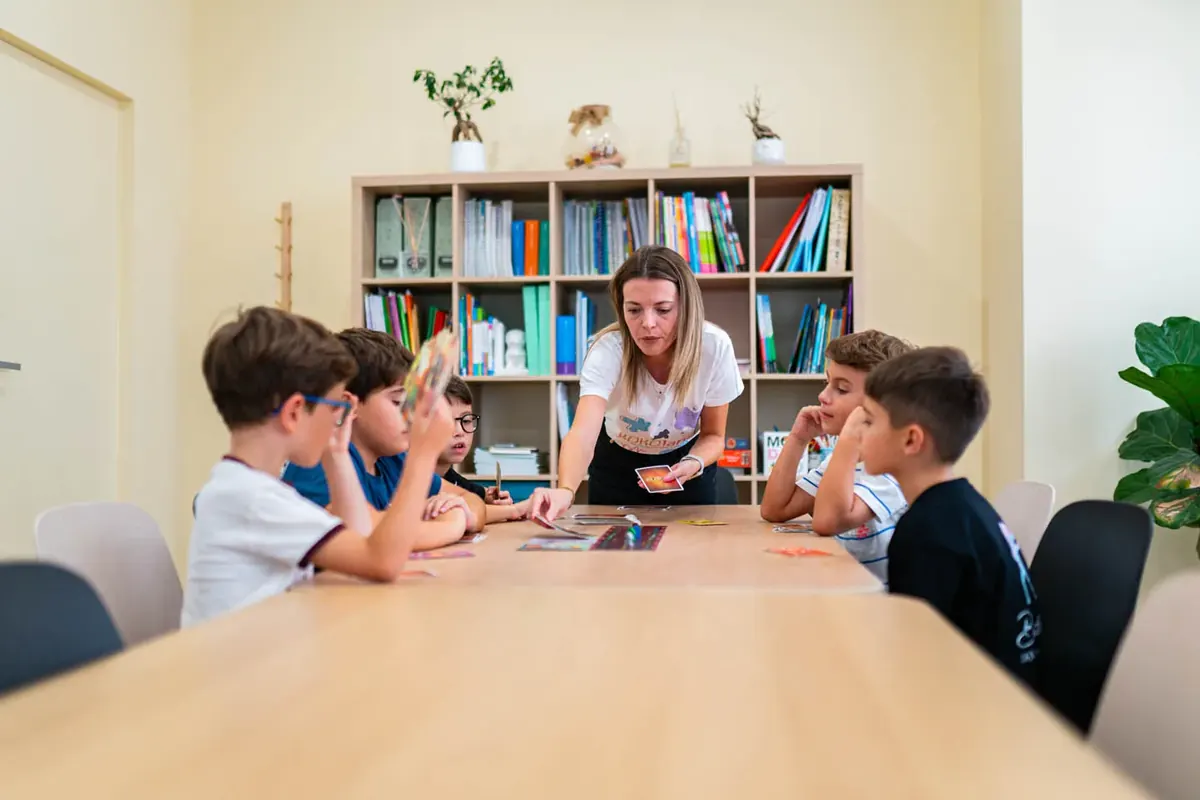
Let’s do a simple sum. In a one-hour English lesson with 20 children, if half the time goes on the teacher explaining and giving instructions, that leaves 30 minutes to share among twenty: a minute and a half of speaking time each, at best. In a group of 6 children, for the same time, it is 5 minutes each.
Language-learning research has confirmed it for years: what counts is the quantity and quality of the English you hear and use, with real people, over many years. We discussed it in the article how many hours of English a week children need. School builds solid foundations; a well-run extracurricular programme adds what is harder to offer in class: speaking time, native-speaker voices, continuity.
How to help at home, even if you don’t speak English
- Ask what they learned, in a concrete way. Not “how was English?” but “will you teach me today’s song?”. A child who plays the teacher revises without noticing.
- Give English a fixed slot. Ten minutes, almost every day, are worth more than a single hour at the weekend: words need to come back often.
- Use the original audio. Cartoons, songs and stories in English train the ear to real pronunciation, exactly what the INVALSI Listening test measures.
- Celebrate the attempts. At six as at ten, a mistake said out loud is a step forward, not a failure.
- Talk to the teacher. In the PDF below you will find the year-by-year table and a few useful questions for the parent-teacher meeting.
Download the year-by-year table and the questions for the parent-teacher meeting (PDF)
The KOKO Primary pathway, alongside school
At KOKOland, from age 7 to 10, there is KOKO Primary: two sessions a week at the school, 60 minutes of dynamic learning and 60 minutes of Creative Lab, in groups of up to 6 children of the same age, with native or bilingual teachers. At home, children carry on with KOKO Play, the learning game in the KOKOland app, 20 minutes a day always matched to the child’s level, with reading, writing, songs and the teacher’s activities: 120 minutes at the school plus 7 days × 20 minutes, over 4 hours of English a week. From age 7, if the family wishes, children can sit Cambridge exams for children at the school, always optional.
Frequently asked questions
How many hours of English are there in Year 1 of Italian primary school?
The reference for state primary schools is one hour a week in Year 1 (age 6–7). It becomes two in Year 2 (age 7–8) and three from Year 3 to Year 5 (ages 8–11). Some schools, thanks to their autonomy, add hours or projects: the timetable is in the school’s PTOF.
How many hours of English are there in Year 5?
Three hours a week, as in Year 3 and Year 4: about 99 hours in a school year, counting about 33 school weeks.
Does the full-time timetable mean more hours of English?
Not automatically: the ministerial reference gives the hours of English per year group (1, 2, 3 hours), without distinguishing between the standard and the full-time timetable. Some schools choose to strengthen English using their own autonomy: you will find it written in the PTOF.
What level of English is reached at the end of primary school?
The target of the national curriculum guidelines is level A1 of the CEFR: understanding and using simple sentences on familiar topics, introducing yourself, reading short texts with pictures. It is the same level as the Cambridge A1 Movers exam.
Does the Year 5 INVALSI English test count towards the school report?
No. The INVALSI test describes the level reached in reading and listening against A1 and is used to evaluate the school system; it is not a mark on the school report.
From which year do children study English in primary school?
From Year 1. With the 2003–2004 reform, English became compulsory in all five years of Italian primary school.
Would you like to see how a KOKO Primary class works? Book the free Demo Day: it is a session inside a real KOKOland class, with children of the same age, in Martina Franca or Monopoli. Send us a request: we look forward to seeing you.
Sources
- Orizzonte Scuola, “Insegnamento della lingua inglese nella scuola primaria” (text of Ministerial Circular no. 21 of 14 March 2011 on teacher staffing)
- Eurydice, European Commission: Italy, Teaching and learning in primary education
- INVALSI, reading guide to the Year 5 English test, school year 2025/2026 (in Italian)
- INVALSI, press release on the 2026 primary school English tests (in Italian)
- Agenzia Dire, “Invalsi 2026: i dati della scuola primaria” (16 July 2026, in Italian)
- Tecnica della Scuola, on the 2012 national curriculum guidelines and the new 2025 ones, in force from 1 September 2026 (in Italian)
- Council of Europe, CEFR: Common reference levels, global scale
Keep reading
Free Demo Day
Book a free Demo Day.
A real, free lesson in a KOKOland class of children the same age. You stay at the school and we explain the method.