
Diwali for children: what the festival of lights is and how to explain it
25 October 202610 min read
In brief
- Diwali is the Indian festival of lights: people light small clay lamps, the diya, because light wins over darkness. In 2026 it falls on Sunday 8 November and lasts five days.
- It is celebrated by Hindus, but also by Jains, Sikhs and Newar Buddhists, each with a story of their own: customs vary enormously from region to region.
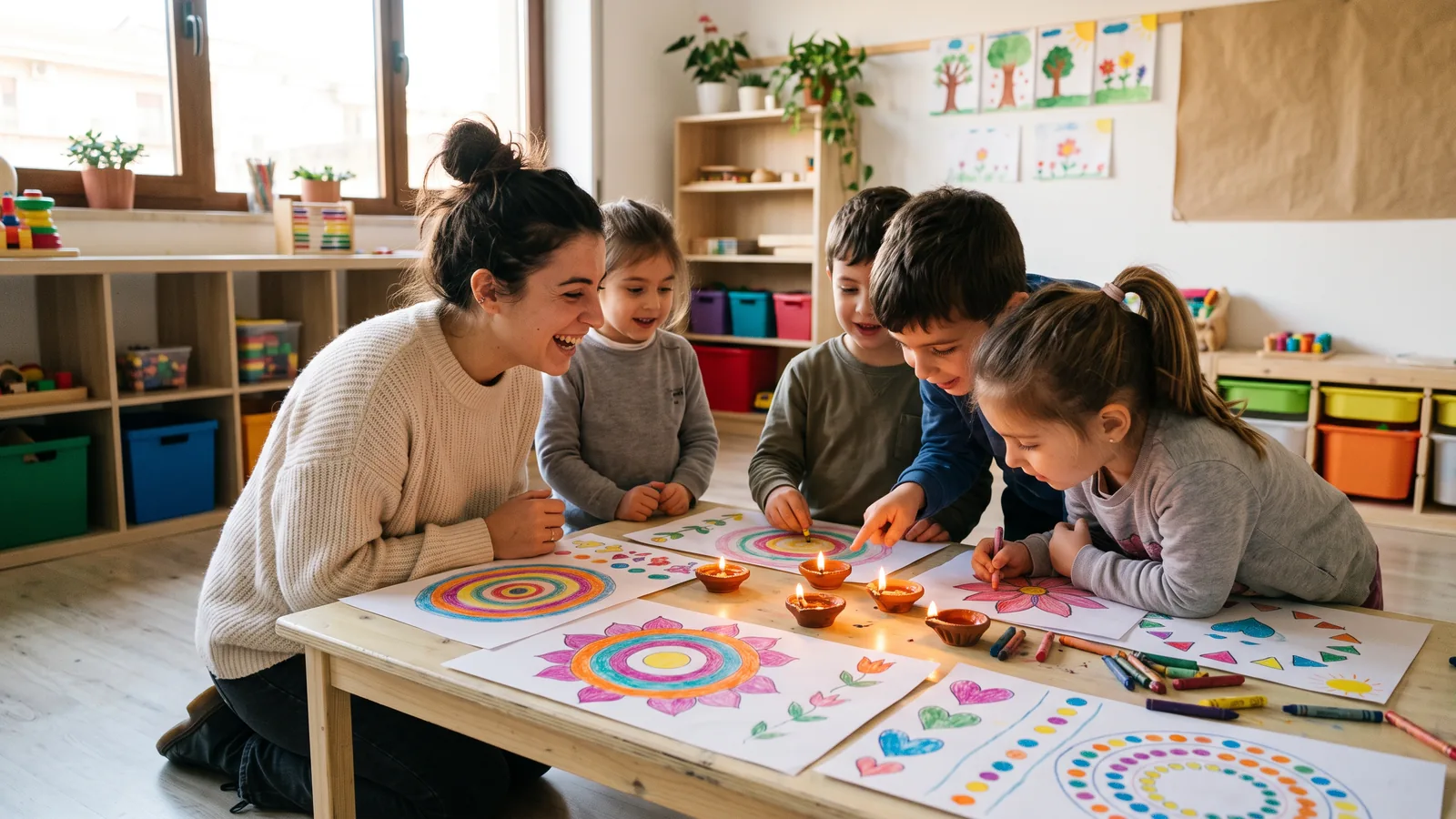
- In front of the house door people draw the rangoli, a welcome pattern of colours and symmetry.
- For English it is a precious occasion: light, colours, wishes. Below you will find the word table with the voice and, at the end, the kit to print.
Diwali is the Indian festival of lights: for five days people light clay lamps and candles to remember that light always wins over darkness, and they make a wish for the year ahead. In 2026 the main day falls on Sunday 8 November.
It is the most important festival of the year in much of India, and one of the best loved by children: lights, colours, sweets, drawings on the ground. Below you will find who celebrates it, what a rangoli is, how to tell the story without oversimplifying it, and what you can do at home.
Three sentences to start from
- the festival greeting, said to everyone you meet
- the first thing to do on the evening
- the sentence that follows
Tap the button, listen to the British voice and repeat together with the child: these three are enough for a whole evening.
What Diwali is
The name comes from the Sanskrit dipavali: dipa, lamp, and avali, row. Literally, a row of lights. It is a religious festival and a family one at the same time: the house is cleaned from top to bottom, decorated with lamps and garlands, people wear new clothes and exchange gifts and sweets.
It lasts five days, each with a name of its own: Dhanteras, Naraka Chaturdashi (or Chhoti Diwali), Lakshmi Puja — Diwali proper, on the night of the new moon — and then Govardhan Puja and Bhai Dooj.
It is not only an Indian festival: it is a public holiday in about ten countries, from Nepal to Trinidad and Tobago, and in the United States in California, Connecticut and Pennsylvania. The British Council describes it to children learning English as a five-day festival of lights, celebrated by millions of Hindus, Sikhs and Jains around the world.
When Diwali falls in 2026
In 2026 the main day is Sunday 8 November; the five days run from 6 to 10 November. The date changes every year because the Indian calendar is lunisolar: in 2025 it was 20 October, in 2027 it will be 29 October.
In Italy Dipavali — the form the State uses for it — is a recognised festival: article 25 of the law of 31 December 2012, no. 246, which governs relations between the Italian State and the Italian Hindu Union (Unione Induista Italiana), provides that the date is communicated every year to the Ministry of the Interior and published in the Gazzetta Ufficiale, Italy’s official gazette. The notice for 2026 came out in the Gazzetta Ufficiale of 5 December 2025 and gives 8 November.
Who celebrates Diwali, and what they celebrate
This is the part that usually gets oversimplified. There is no single Diwali: the same night remembers different things depending on the region and the religion.
- Hindus. In the north people remember Rama’s return to Ayodhya, welcomed by lamps lit along the road. In Bengal the night is dedicated to the goddess Kali; in Assam and in several communities in the south, people celebrate Krishna’s victory over the demon Narakasura; in Gujarat it marks the start of the new year. Almost everywhere people honour Lakshmi, the goddess of prosperity.
- Jains remember the nirvana of Mahavira, the last tirthankara; their new year begins the next day, and many avoid firecrackers out of respect for non-violence.
- Sikhs celebrate Bandi Chhor Divas, the “day of the release of the prisoners”: the return to Amritsar of the sixth guru, Hargobind, freed from imprisonment in Gwalior fort. The Golden Temple is lit up with thousands of lights.
- Newar Buddhists, in Nepal, celebrate it under the name Swanti.
Hence a rule that holds in the classroom too: “in many parts of India”, not “in India”; “one of the stories”, not “the story”.
Why it is called the festival of lights
Because light is not a decoration: it is the very meaning of the festival. Diya are small clay lamps filled with oil, with a cotton wick, and they are lined up by the dozen on windowsills, low walls and the doorstep. Those rows of little flames say one thing only, the same in every tradition of the festival: light wins over darkness, good over evil, knowledge over ignorance.
Beside the lamps there are the sweets, the mithai, which are made at home and given to the neighbours, and the fireworks. It is worth being precise about these with older children: a much-loved tradition, but also the most debated, because in big Indian cities they worsen air quality, and in several cities they have been restricted (article in Italian).
What a rangoli is
The rangoli is the drawing made on the ground, in front of the house entrance, early in the morning, after cleaning. It is made with coloured powders, rice flour, sand or petals. It is not a painting: it is a gesture of welcome, for whoever arrives and, according to tradition, for Lakshmi.
The patterns are geometric and symmetrical, built on a grid: square in the north of India, hexagonal in the south. And they change name from region to region: kolam in Tamil Nadu, muggu in Andhra Pradesh, alpana in Bengal, pookkalam in Kerala, where it is made with flowers.
Children love one thing above all: a rangoli does not last. It wears away under people’s feet and is made again the next day.
How to explain Diwali to a young child
With one sentence and one gesture, not a history lesson. The sentence, for ages three to six: “In India there is a festival where lots of little lights are lit. It is called Diwali. They remind us that light is stronger than darkness.” Then you switch off the room light and light a candle: the silence that follows is the best part.
Then comes the wish: at Diwali people make a wish for the year ahead, and a child understands that at once. From six or seven you can add one of the stories — Rama coming home and finding the road lit up — while saying that it is one of the stories.
Three things, instead, are best avoided:
- Calling it “the Indian Christmas”. It is not: it has a history, a calendar and a meaning all of its own.
- Dressing children up “as Indians”. Lighting a lamp, making a rangoli, learning a word are ways of taking part; a costume is not.
- Reducing everything to fireworks. The noisiest part, and the least important.
How it went in class: the Diwali workshop
This week, in KOKOland classes, Diwali was a workshop entirely in English, in four moments. The order, more than the activities, is the part you can repeat at home.
- First you watch. A short video about what Diwali is, with the questions written on the board in English: the words arrive together with the images, and nobody has to speak yet.
- Then you light. Lights off and a single candle, passed from hand to hand: everyone lights their own light and makes a wish. The classroom goes quiet on its own.
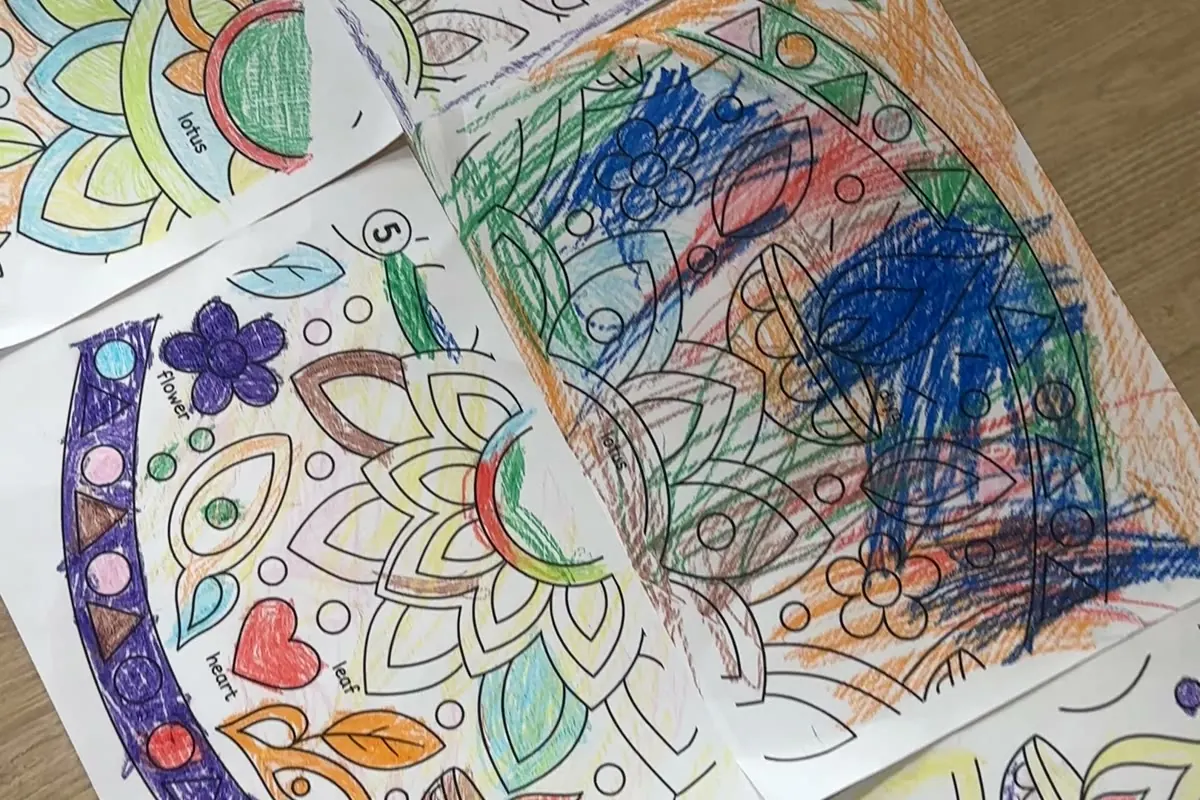
- Then you make with your hands. Everyone colours their own rangoli, on the symmetry grid, with the shapes written in English: star, flower, heart, leaf, lotus, diya. While colouring, the children ask for colours, and the words come out by themselves.
- Finally you dance. A Diwali dance at the board, and then all together: “Happy Diwali!”.
Watch, light, make, move: that way every word stays attached to a gesture. It is the same principle as the English games to play at home.
Which English words you learn with Diwali
They are the words of light and colour: concrete, short, tied to an object. Tap the button to hear the British pronunciation.
| In English | What it means | A sentence to use it |
|---|---|---|
| the glow you see when a lamp or a candle is lit | Said while pointing at a flame. | |
| the small clay lamp of Diwali | Said while holding one. | |
| a wax stick with a flame on top | The first sentence for the lighting game. | |
| red, yellow, green, blue… | Counting colours while colouring the rangoli. | |
| a shape that repeats again and again | What you say on the symmetry grid. | |
| something you hope for in the year ahead | One wish, one sentence. | |
| the mithai that families make and give away | Said when the plate goes round. | |
| bright bangs and sparks in the night sky | Best said from far away, with hands over ears. | |
| the drawing on the doorstep | Said while working on the grid. | |
| the opposite of light | The sentence that sums up the festival. |
A note: colours with a u is British, colors American. And to wish someone a happy Diwali you say Happy Diwali!; in the south of India also Happy Deepavali!.
The Diwali quiz
What you can do at home
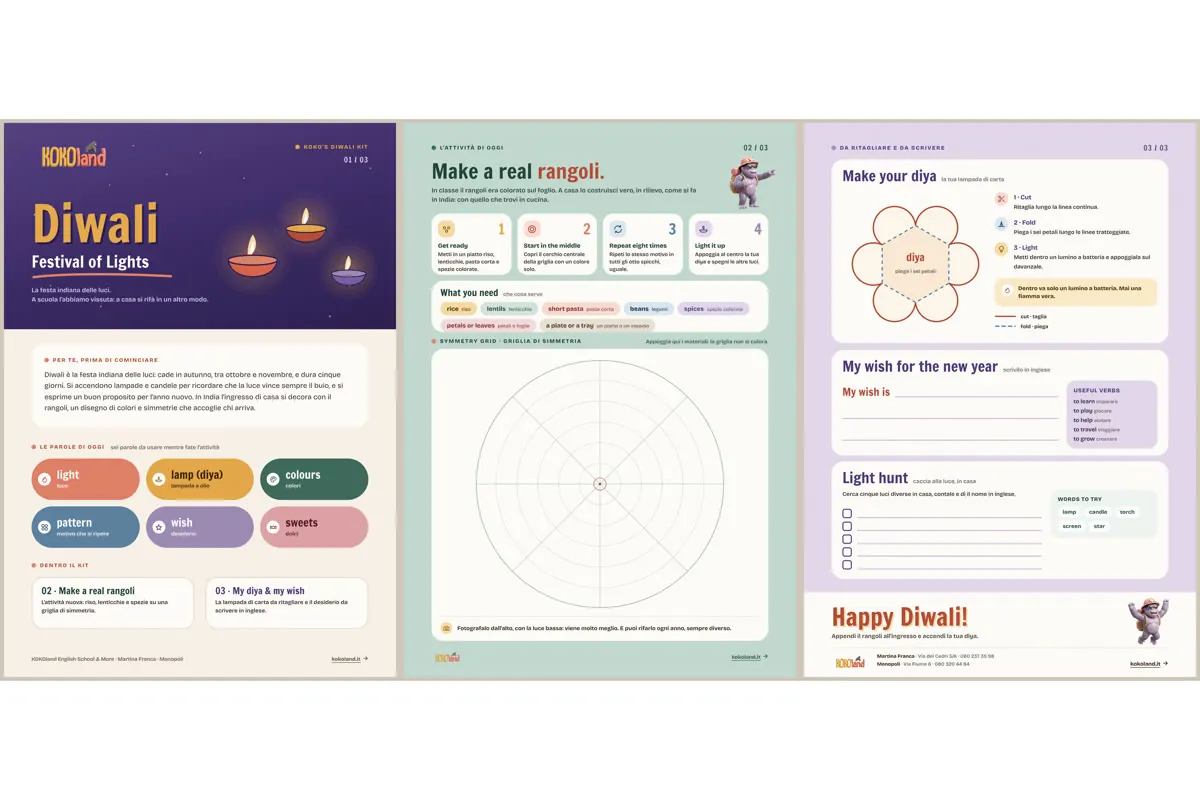
Half an hour and whatever you already have in the kitchen is enough. The activity is gathered in KOKO’s Diwali Kit: three pages to print, designed to be done together.
- The real rangoli, in relief. Rice, lentils, short pasta and coloured spices on a symmetry grid: start from the central circle with a single colour and repeat the same pattern in the eight segments. Photograph it from above, in low light.
- The paper diya. Cut it out, fold the six petals and put a tealight inside: battery-powered only, never a real flame.
- The wish in English. A line to complete, My wish is…, with four verbs: to learn, to play, to help, to travel.
- Light hunt. Look around the house with a child for five different lights, count them and say their names in English: lamp, candle, torch, screen, star. Five minutes every evening.
Frequently asked questions
What is Diwali, explained to children?
It is the Indian festival of lights: for five days small clay lamps, the diya, are lit to remember that light is stronger than darkness. For a young child it is enough to say that in India there is a festival where lots of little lights are lit, because light wins over darkness.
When is Diwali in 2026?
In 2026 the main day falls on Sunday 8 November, and the five days run from 6 to 10 November. The date changes every year because the central day is the new-moon day between mid-October and mid-November.
Why is Diwali called the festival of lights?
Because the name says so: from the Sanskrit dipavali, “row of lights”. In homes, rows of oil lamps, the diya, are lit on windowsills and doorsteps: they stand for the victory of light over darkness, good over evil and knowledge over ignorance.
What is a rangoli and how do you make one at home?
It is the drawing that in India is made on the ground, in front of the entrance, with coloured powders, rice flour or petals, to welcome whoever arrives. At home you build it on a tray with rice, lentils and spices, repeating the same pattern in every segment of the grid.
Who celebrates Diwali besides Hindus?
Also Jains, who remember the nirvana of Mahavira, and Sikhs, who celebrate Bandi Chhor Divas, the release of the sixth guru, Hargobind. In Nepal the Newar Buddhists celebrate it.
Which English words do you learn with Diwali?
The words of light and colour, among the first that children learn: light, candle, diya, colours, pattern, wish, sweets, fireworks. They are concrete, tied to a gesture, and that is why they stay: in the table each one has a button for the pronunciation.
How do you say “happy Diwali” in English?
You say “Happy Diwali!”. In the south of India and in several English-speaking countries you also hear “Happy Deepavali!”, from the older form of the name.
The festival ends, the English stays
A festival like Diwali says something that holds all year round: learning English is not only learning words, it is understanding how the people who speak those words live. This is how we work at KOKOland, in groups of up to 6 children of the same age, with native-speaker or bilingual teachers; enrolled families carry on at home with KOKO Play, our educational game in English. You will find us in Martina Franca and in Monopoli, from age 1 to 18.
After Diwali comes December, with its own English: you will find it in Christmas in English for children. And if you would like to see how English is taught in a real class, we look forward to seeing you at the free Demo Day, together with children of the same age.
Keep reading
Free Demo Day
Book a free Demo Day.
A real, free lesson in a KOKOland class of children the same age. You stay at the school and we explain the method.