
KOKO Play: the English learning app for kids, born in a school
13 October 20266 min read
In short
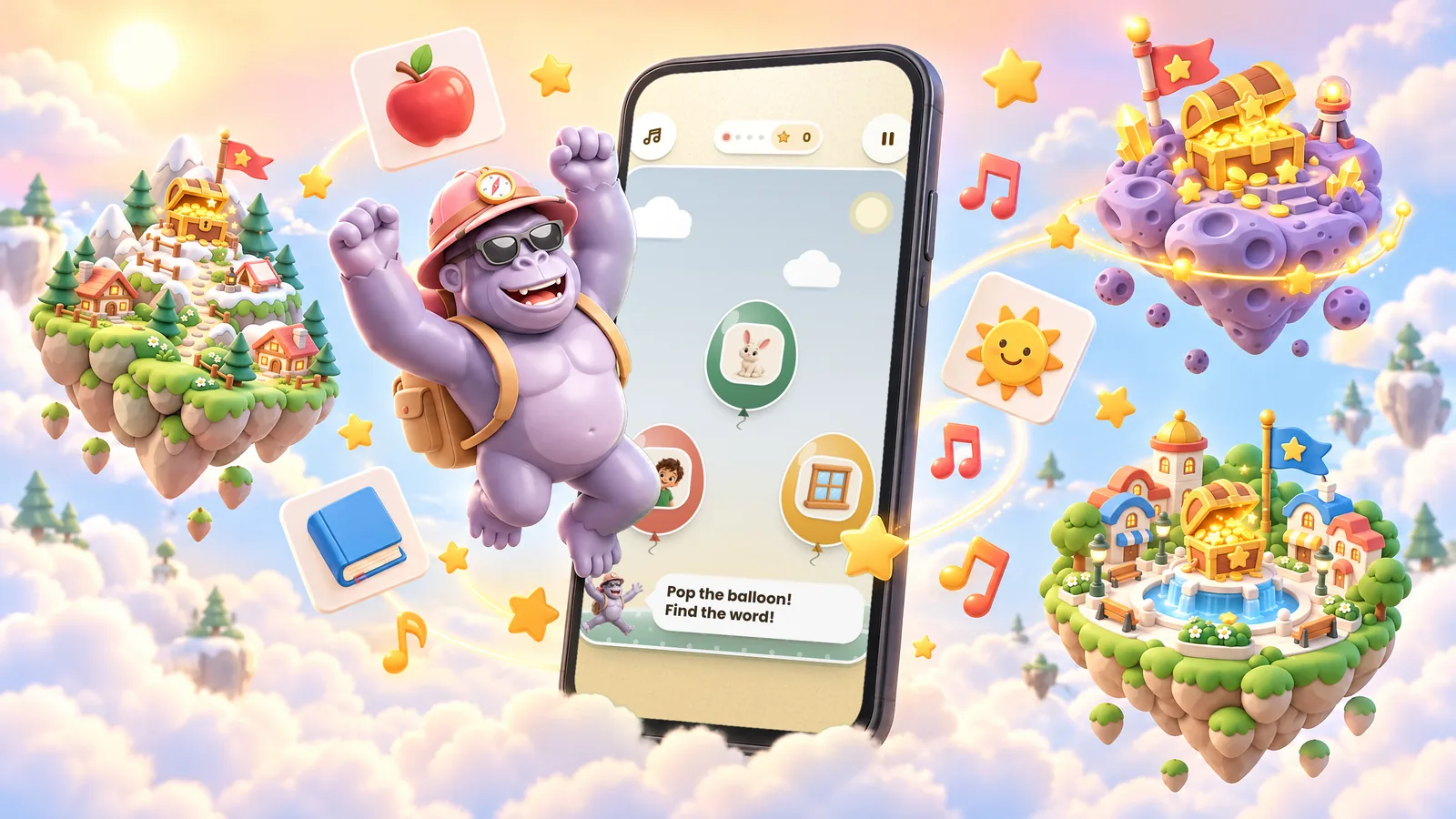
- KOKO Play is the English learning app we designed and built at KOKOland: games, songs and challenges in English, about 20 minutes a day, from age 3 to 18, plus plenty of activities to do together for the little ones.
- An algorithm follows every answer and keeps the level just right: when something gets easy the challenge goes up, when it's hard it comes back another way. Never too easy, never too hard.
- It picks up the words being taught in class: with 120 minutes at school and KOKO Play at home every day, that's over 4 hours of English a week.
- For now, KOKO Play is reserved for families enrolled at KOKOland.
Look for an English learning app for kids and you'll find hundreds. Many look lovely, but hardly any of them know what children are doing in class this week, and few notice when a game has become too easy, or too hard. That's why at KOKOland we chose to build our own: KOKO Play, an interactive game designed by an English school, with its teachers, for its children and teens.
Why a school built its own app
At school English is learnt with people: native or bilingual teachers, groups of up to 6 children of the same age, a different activity about every 15 minutes. But a week has 7 days, and new words need to come back often to stick. We wanted the days in between to become real English, without boring homework and without screens left to chance.
That's how KOKO Play was born: a one-of-a-kind app, designed and built by KOKOland, that speaks the same language as the classroom. Same topics, same words, same Koko, the gorilla children already know.
How we designed it for real learning
A team of researchers led by Kathy Hirsh-Pasek set out what makes an app truly educational: children must be active (thinking, choosing, answering), engaged without distractions, doing something meaningful to them, and connected with people. We built KOKO Play around these four ideas, and three more that memory research knows well.
Words come back at the right time
Revising everything at once works poorly; spreading practice over time works much better. A large synthesis of hundreds of experiments confirmed it (Cepeda and colleagues, 2006). In KOKO Play every word comes back after a while, then after a longer while: when it's remembered it moves further away, when it's missed it comes back soon.
Remembering, not just reviewing
Trying to recall a word fixes it far better than re-reading it (Roediger and Karpicke, 2006). That's why in KOKO Play words aren't just looked at: they're found, chosen, said and written, in ever-changing games.
The right challenge
We learn most when we succeed most of the time, but not every time: a task that's too easy is boring, one that's too hard is discouraging (Wilson and colleagues, 2019). It's the principle that tunes the whole of KOKO Play.
The algorithm that raises the level, every day
Inside KOKO Play there's an algorithm we developed ourselves. It follows every answer and works out which words a child already knows and which are still on their way. Then it picks today's games: if something gets easy it raises the challenge, if it's hard it brings it back another way, with a little extra help. It changes one thing at a time, always within what their age allows.
The result is a level that rises day after day, with no jumps and no walls: never too easy, never too hard. And children only feel the good part: the feeling of getting it right.
How it works, day by day
KOKO Play is used for about 20 minutes a day. For the little ones you choose the time, 10, 15 or 20 minutes, and it applies across all devices. Every day there's a new path, with different games, a challenge and something to win; if you like, we send you a reminder at the time you prefer, only on days they haven't played yet. In the same app you'll also find the activities and homework the teacher sets for home, always interactive and playful.
Songs with pictures and KOKO Karaoke
Songs are one of the most effective ways to bring new words to young children: in a study with pre-school children, listening to and singing a song led them to recognise many new words (Coyle and Gómez Gracia, 2014). In KOKO Play every song becomes a video: the pictures show what the lyrics say, as they say it. And with KOKO Karaoke everyone sings word by word.
Speaking English with Koko
Learning a language also means using it. In the voice games children answer Koko out loud: they repeat a word, say it to launch a rocket, chat with him. You decide about the microphone from your profile, and the voice is never saved or sent. If you switch it off, the games are played by tapping.
A different game for every age
- KOKO Babies (ages 1–2): over 40 activities to do together at home, songs and lullabies in English.
- KOKO Stars (ages 3–6): pictures, voice and songs, no reading needed.
- KOKO Primary (ages 7–10): reading and writing, with richer and richer word and sentence games.
- Junior (ages 11–13) and Teens (ages 14–18): their own worlds, Explorer Universe and The Nexus, their own Avatar to customise, their own leaderboard, 20-minute sessions and exam practice set by the teacher.
The app doesn't replace the class: it extends it
Research reminds us that children learn a language mainly from people (Kuhl and colleagues, 2003). That's why KOKO Play doesn't take the place of the class: it carries it on. At school there are 60 minutes of dynamic learning and 60 minutes of Creative Lab (for Junior and Teens, LANGUAGE LAB and SPEAK UP); at home, with KOKO Play, 20 minutes a day for 7 days.
Let's do the maths: 60 minutes + 60 minutes + 7 days × 20 minutes = 260 minutes. Over 4 hours of English a week, nearly all of it through play. Why minutes matter is explained in our article on how many hours of English a week a child needs.
Who can use KOKO Play
For now, KOKO Play is reserved for families enrolled at KOKOland, in Martina Franca and Monopoli: it opens from the KOKOland app, together with everything you need during the year. Our development team improves it every day, with new games and new songs. All the features are on the KOKOland app page; to see it live, together with a real class, you can book the free Demo Day.
Frequently asked questions
What is a good English learning app for kids?
A good app keeps children actively working, adapts to their level, brings words back over time and connects with what they learn with people. KOKO Play is built on these principles and linked to KOKOland's classes.
How long a day is KOKO Play used?
About 20 minutes a day. For the little ones the parent chooses 10, 15 or 20 minutes.
Does the level adapt to the child?
Yes. An algorithm follows every answer and offers easier or harder games depending on how they play, so the level rises without ever being too easy or too hard.
Can KOKO Play be downloaded without being enrolled?
Not at the moment: KOKO Play is reserved for families enrolled at KOKOland. To get to know the school you can book the free Demo Day.
Sources
- Hirsh-Pasek, Zosh, Golinkoff, Gray (2015), Putting Education in “Educational” Apps: Lessons From the Science of Learning, Psychological Science in the Public Interest
- Cepeda, Pashler, Vul, Wixted, Rohrer (2006), Distributed practice in verbal recall tasks: A review and quantitative synthesis, Psychological Bulletin
- Roediger, Karpicke (2006), Test-Enhanced Learning: Taking Memory Tests Improves Long-Term Retention, Psychological Science
- Wilson, Shenhav, Straccia, Cohen (2019), The Eighty Five Percent Rule for optimal learning, Nature Communications
- Coyle, Gómez Gracia (2014), Using songs to enhance L2 vocabulary acquisition in preschool children, ELT Journal
- Kuhl, Tsao, Liu (2003), Foreign-language experience in infancy, PNAS
Keep reading
Free Demo Day
Try a free Demo Day.
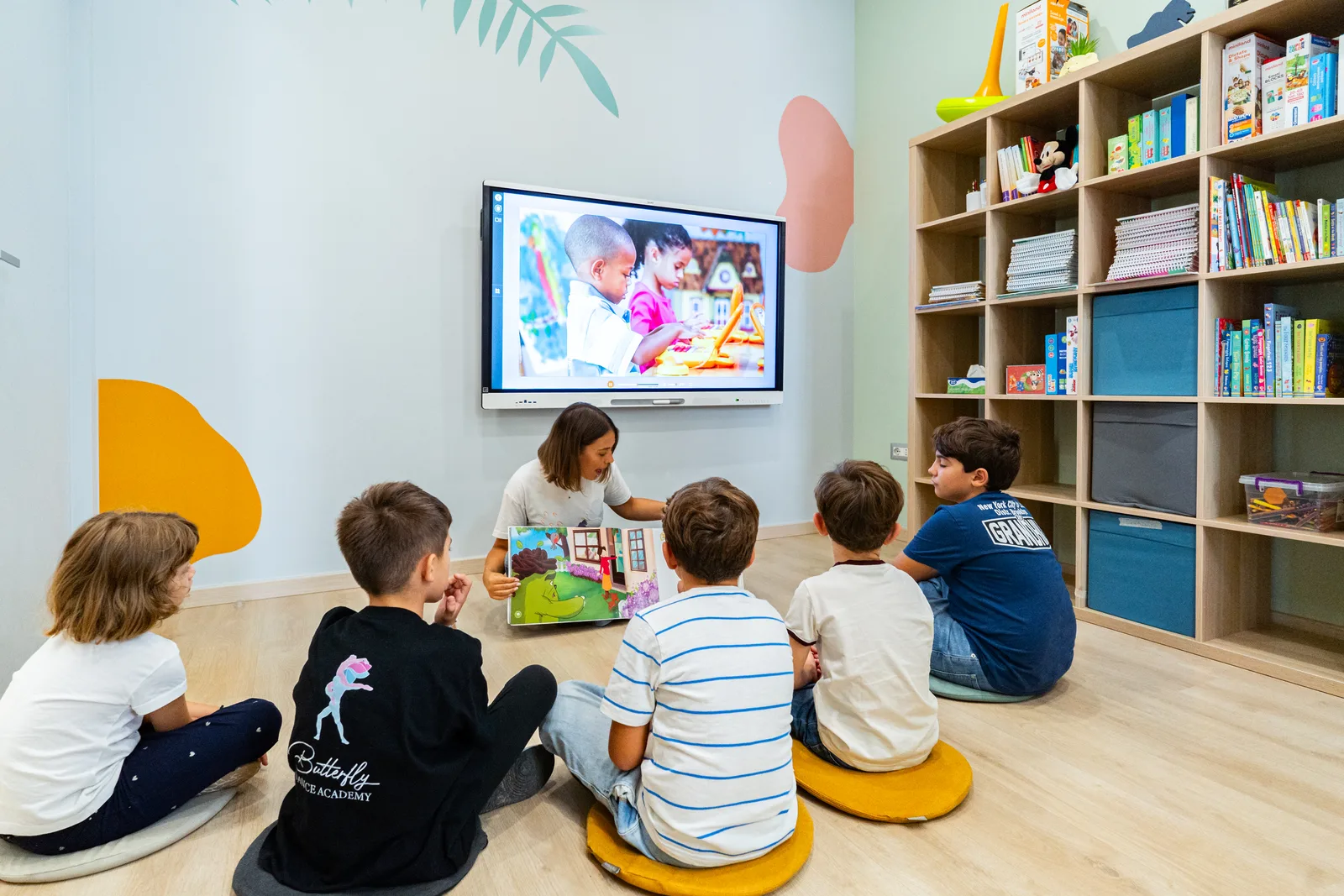
A real, free lesson in a KOKOland class of children the same age. You stay at the school and we explain the method.