

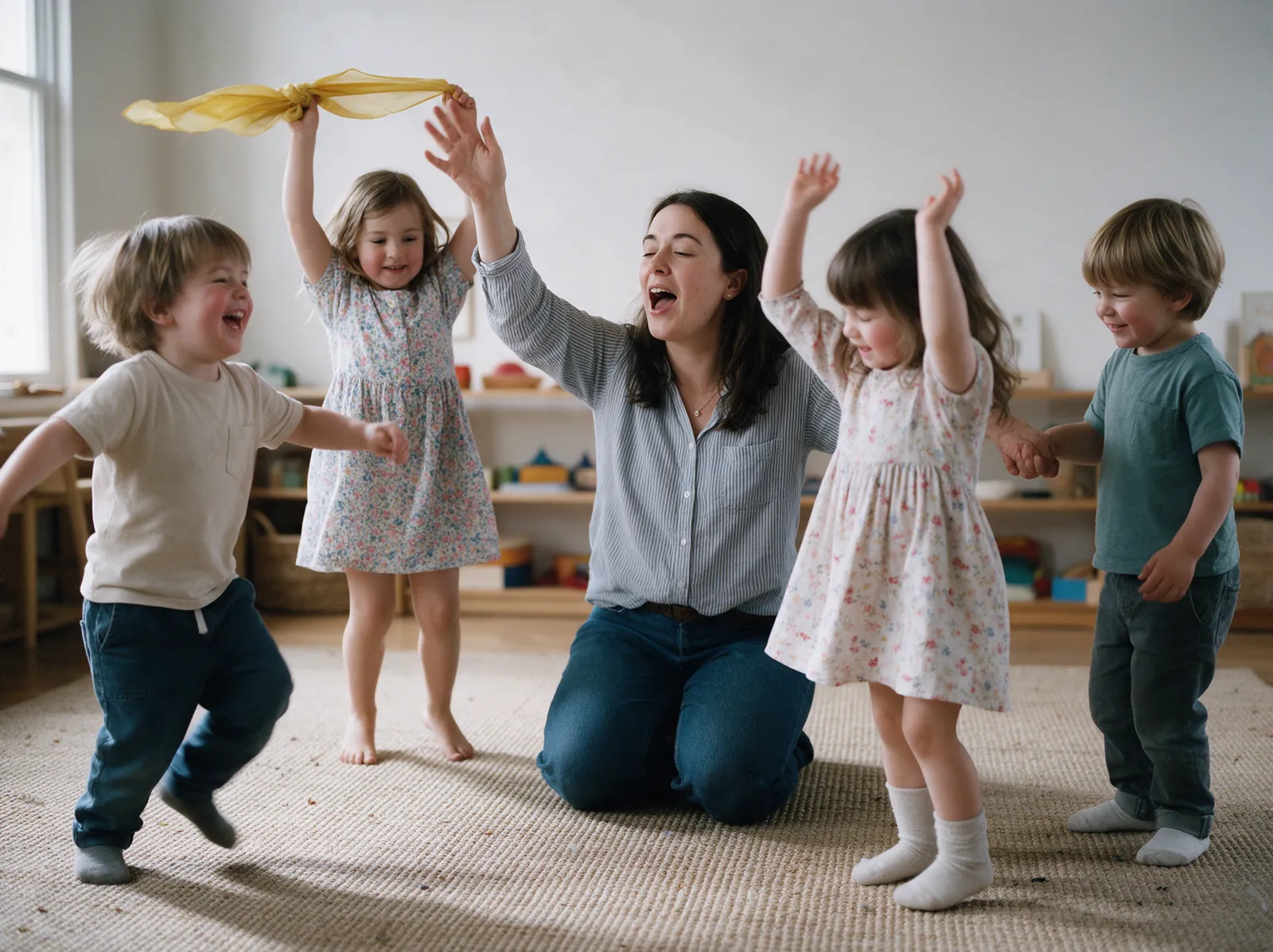

Songs
Words stick through rhythm and movement: singing, dancing and repeating without even noticing.
Trains: PronunciationListeningMemory
The KOKOland method · ages 3–18
It’s KOKOland’s own method: in 60 minutes the activity changes roughly every 15, across 4 different moments, while the theme of the week stays the same. Groups of up to 6 children the same age and native-speaker or bilingual teachers: that way, attention stays high from the first minute to the last.
Why it works
To really learn, we need all 60 minutes of their attention. With a single activity, attention slowly drops; with dynamic learning, it bounces back at every change.
Same theme, always a different form: lots of repetition, and nobody gets bored.
The theme of the week moves from song to game, from book to role-play: the same words come back again and again, each time in a new form.
A calm moment is followed by a lively one, and vice versa.
For the children it’s an hour of games, songs and stories; meanwhile they listen, speak and use English for real.
An hour of dynamic learning
An illustrative example with the theme of the week “food”: in 60 minutes the same words come back four times, in four different forms. The activities change every week and are designed for each age.
Scroll: the hand goes round the hour
Everyone starts on their feet: the song of the week brings in the new words (apple, banana, pizza…) and fixes them with rhythm and actions.
The same words become a game: touching, dragging, matching sounds and pictures, taking turns. Everyone has a go, and everyone cheers.
Out comes the book for their age: an illustrated story with the same words, pictures to point at and, for older children, first reading and writing.
Time to play market: the teacher runs the stall and the children go shopping. “Can I have an apple, please?”: the words of the week are used for real.
In one hour the same word has come back four times: sung, played, read and used. And attention stayed high right up to the last minute.
The hour at a glance
Illustrative example: activities and their order change from week to week and depending on age.
The activities
Every session alternates four moments, chosen from these and blended according to age. Each one trains something specific.
Words stick through rhythm and movement: singing, dancing and repeating without even noticing.
Trains: PronunciationListeningMemory
Touching, dragging, matching sounds and pictures, taking turns; quizzes and team challenges for older kids.
Trains: ListeningVocabularyReading
The book for their age: illustrated stories and pictures to point at, then reading and writing.
Trains: ReadingWritingVocabulary
At the shop, at the restaurant, on a trip: new phrases are used straight away, in a real scene.
Trains: SpeakingUseful phrasesConfidence
In a circle or in teams, to put what they’ve just heard straight into use.
Trains: ListeningSpeakingTeamwork
Cards, dice and boards in English: waiting your turn, counting, asking and answering.
Trains: SpeakingVocabularyTurn-taking
Colouring, cutting, building: the instructions are in English and words become things you can touch.
Trains: VocabularyInstructionsCreativity
Listening, guessing what happens next, answering: the story ties the words of the week together.
Trains: ListeningUnderstandingImagination
It grows with them
Dynamic learning grows with the children: the ingredients and how they’re blended change, the rhythm doesn’t. From age 3, each level has annual goals and an age-appropriate Cambridge book, and the method is updated every year.
The ingredients at this age · KOKO Stars, ages 3–6
In Stars 1, movement and songs take centre stage; in Stars 3, there’s more room for the book, longer stories and first letters.
Discover KOKO StarsThe ingredients at this age · KOKO Primary, ages 7–10
In Primary 1 there’s more play and more speaking; year by year, reading, writing and Cambridge-style activities grow.
Discover KOKO PrimaryThe ingredients at this age · Junior, ages 11–13
English through interaction: from studying the language to using it in real situations, to understand, interact and communicate with growing independence. SPEAK • COLLABORATE • THINK • COMMUNICATE.
Discover JuniorThe ingredients at this age · Teens, ages 14–18
English through real communication: English becomes a tool for self-expression, discussion, exchanging opinions and handling real situations. DISCUSS • EXPRESS • THINK • COMMUNICATE.
Discover TeensAnd at ages 1–2?
KOKO Babies has a format all of its own: 45 minutes a week with a parent in the room, with songs, movement, sensory play and little stories with Koko the gorilla and the Koko Friends.
The week
From age 3 to 18 there are two 60-minute sessions a week, 120 minutes in total, included in the fee. Stars and Primary: dynamic learning and Creative Lab. Junior and Teens: LANGUAGE LAB — building the language and SPEAK UP — using the language.
Dynamic learning
With peers at their own level, up to 6.
Creative Lab
Cooking, gardening, yoga, art, drama, experiments, music… all in English.
LANGUAGE LAB
Building the language: grammar and vocabulary in context, pair and group activities, Cambridge preparation.
SPEAK UP
Using the language: conversation, opinions, problem solving and real situations, with up to 6 students.
With a parent in the room
Songs, movement, sensory play and little stories with Koko. Up to 5 children.
Sensory labs
On top, from October to June: touching, listening, discovering.
Who and how
Groups of up to 6 children or teenagers the same age; in KOKO Babies up to 5, each with a parent. That way everyone speaks, is listened to and gets support.
All trained in the KOKOland method. The same team follows the children through the year, in the labs and at KokoCamp in summer.
From KOKO Babies to Teens, every stage has age-appropriate goals. From age 3, the Cambridge book supports the pathway, always alongside peers.
All coursesPreparation is part of the pathway, from Pre A1 Starters to B2 First; the family decides whether to sit the exam.
Cambridge examsA playful orientation test on entry; during the year, regular updates for families and meetings with the teaching team whenever needed.
Play with KokoUnderstanding comes first, and the words follow on their own: play and small groups help even the shyest children come forward.
At home
No compulsory homework: those who want to can carry on at home with two tools.
For parents
Optional activities to do at home, set by the school: for children on their own or to do together, parent and child. Plus notices, classes and timetables, make-up sessions and payments.
For children and teenagers
Cambridge’s official digital platform, linked to the course book: activities, songs, videos and games at the same level, always optional.
A method of our own
Dynamic learning is KOKOland’s own method: it was born in our classrooms, it grows with the children and it’s updated every year. KOKOland is an independent school, not a franchise: there are no royalties to pay to a network, so resources stay here, in the method, in teacher training and in the classrooms.
Where resources stay
FAQ
It’s KOKOland’s own method for teaching English to children and teenagers aged 3 to 18. In a 60-minute session the activity changes roughly every 15 minutes (games, the Cambridge book, arts & crafts, the interactive whiteboard, board games, role-play with the teacher, songs, stories), while the theme of the week stays the same and comes back in different forms.
Free Demo Day
A dynamic learning activity in English, in a small group of children their own age, with the teaching team.
Updated on 27 September 2026