
In brief
- From 1 to 6, English is learned from people: in a University of Washington study, 9-month-old babies learned the sounds of a new language from people talking with them, not from a video.
- Repetition is an ally: 3-year-olds who heard the same story again and again learned new words; those who heard a different story each time didn’t.
- Play, routine and small groups are at the heart of KOKO Babies (1 and 2 years) and KOKO Stars (3–6 years).
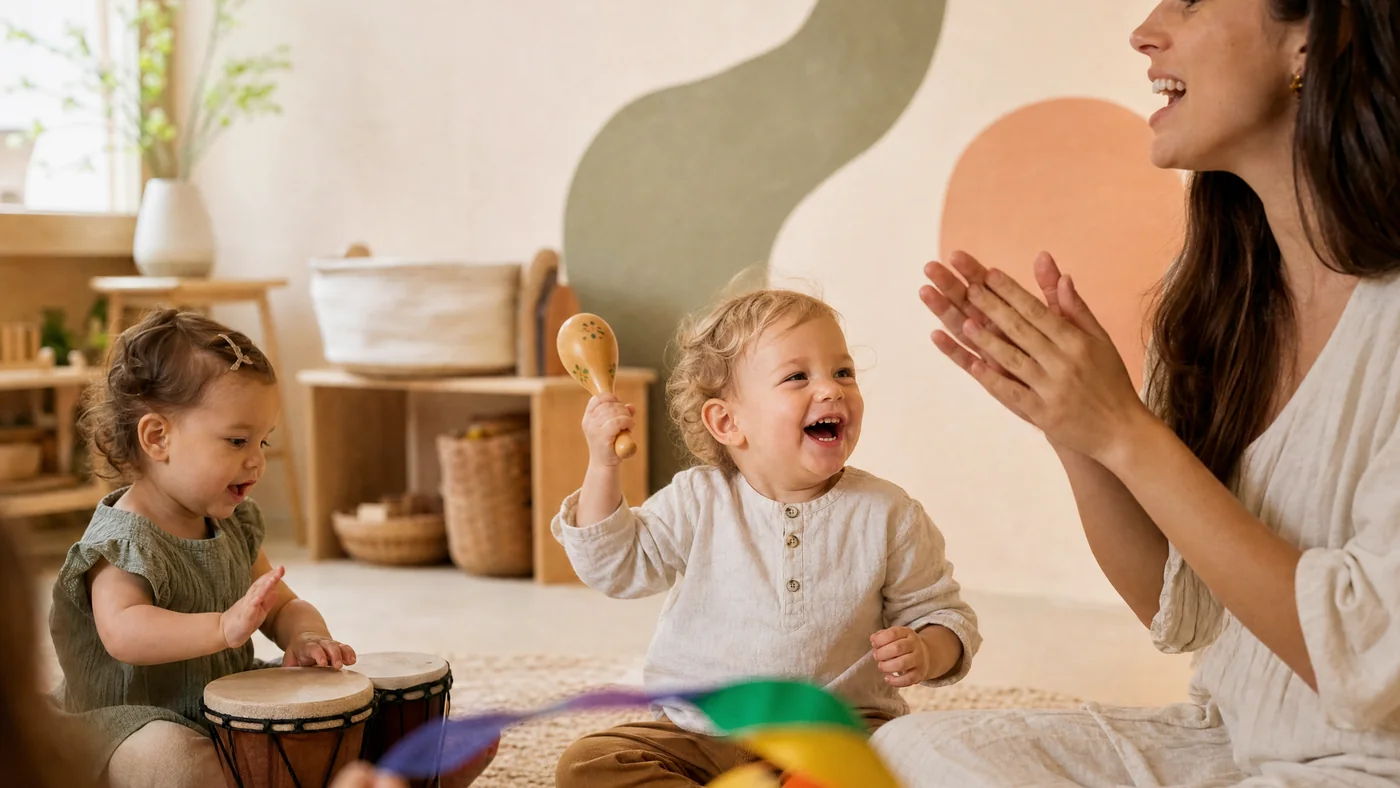
Picture a KOKO Babies classroom. Koko the gorilla comes out of his bag, the song “Hello Koko” starts, and a two-year-old who, moments before, was in mum or dad’s arms, stands up and claps along in time. No one has explained what “hello” means: the child just knows, because they’ve heard it and sung it so many times, always at the same moment. This is how children from 1 to 6 learn English: through people, through play, through repetition, and through routine.
At this age, a second language is acquired mostly implicitly: children encounter it while doing things that interest them, absorbing its sounds, words and structures along the way. The adults’ job is to create the right opportunities. Let’s look at what those are.
1. A person, first of all
The first ingredient is the relationship. The Center on the Developing Child at Harvard University calls the back-and-forth exchange between a child and an attentive adult “serve and return”: the little one babbles, points or smiles, and the adult responds with a look, a word, a gesture. It’s these exchanges that build and strengthen the brain connections needed for communication.
The same holds for a second language. In the study by Patricia Kuhl and colleagues (PNAS, 2003), 9-month-old babies learned to distinguish the sounds of Mandarin Chinese after 12 sessions of 25 minutes with real people. The same content, delivered on video or audio only, had no effect at all.
What about cartoons in English?
They’re a side dish, not the main course. The Italian Society of Paediatrics recommends avoiding smartphones and tablets before age 2, and no more than an hour a day between ages 2 and 5, noting that under age 3 children learn new words from a video only if a parent is close by. The World Health Organization also advises against screens before age 2, suggests no more than an hour a day between ages 2 and 4, and encourages reading and storytelling together with an adult.
2. Play gives children a reason to speak
In play, language has a purpose. In KOKO Babies, Koko the gorilla gets hungry, loses his ball, gets sleepy: children don’t have to answer questions, they have to help him. “Give Koko the ball” isn’t an exercise, it’s a mission.
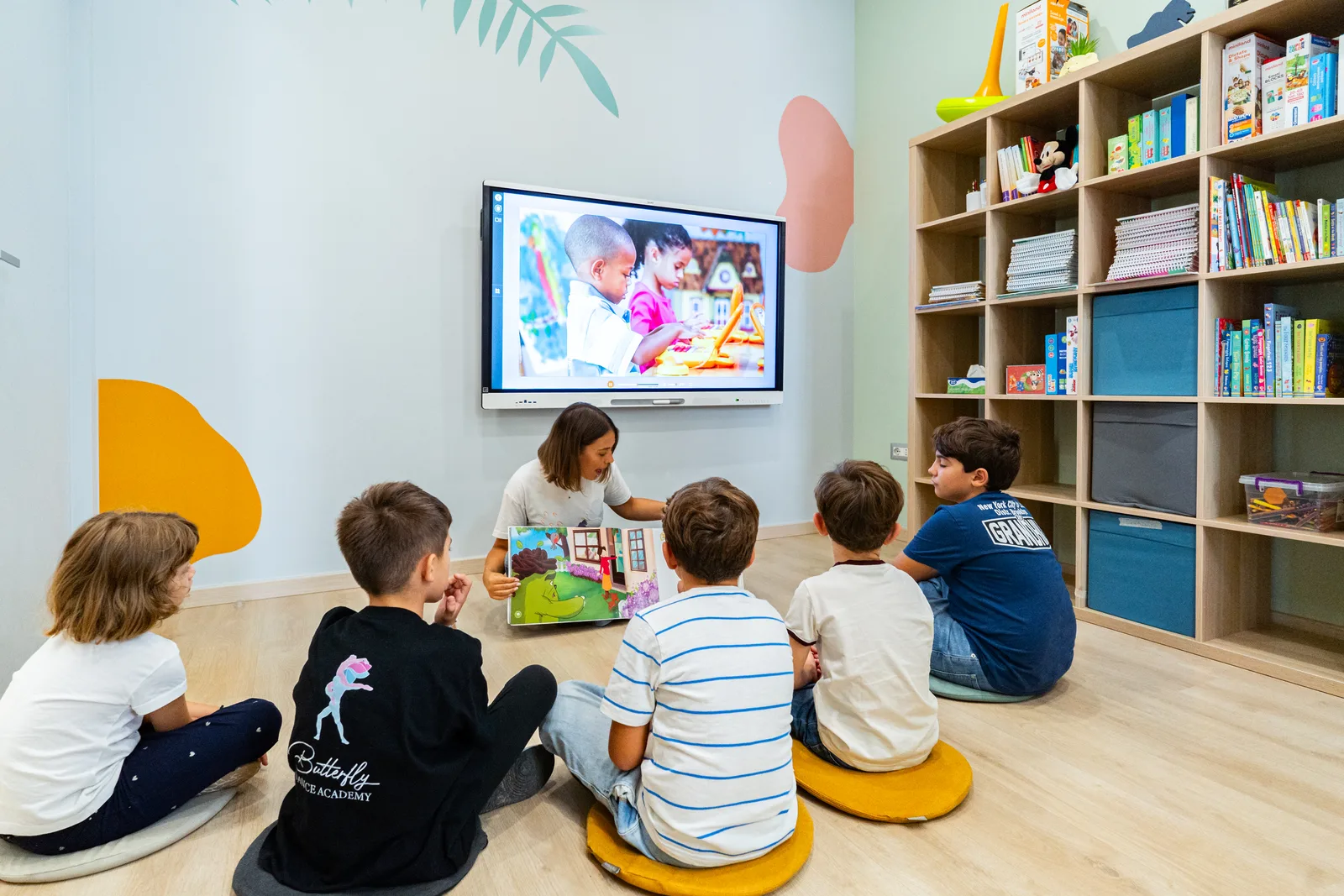
With KOKO Stars, play grows along with the children: interactive whiteboard games, dancing, songs, little challenges between classmates. In the dynamic learning session, the topic stays the same, but the activity changes roughly every 15 minutes: this keeps attention high and brings the same language back in ever-new forms. And there are no desks in the classroom. That’s not by chance.
3. Repetition turns sounds into understanding
Adults get tired of hearing the same song for the tenth time. Children don’t, and they’re right not to. In a study published in Frontiers in Psychology (Horst, Parsons and Bryan, 2011), 16 three-year-olds were read illustrated stories three times over the course of a week, containing made-up words invented for the experiment. Those who heard the same stories again and again learned and remembered those words; those who heard a different story each time, despite hearing the words just as often, didn’t learn them.
That’s why the same songs open and close every session in our classrooms, “Hello Koko” and “Goodbye Koko”, and the same phrases return for months with just one word changing: “Give Koko a hug”, “Give Koko the ball”, “Give Koko the banana”. A few words, used to the full.
4. Routines build confidence
A routine is an action repeated the same way every time: the greeting, the tidy-up song, the story before saying goodbye. For a young child, routine is a map: they know what’s coming next, they feel safe, and they have energy free to listen.
Every KOKO Babies session has the same shape, week after week. Even the Koko Friends, Koko’s puppet friends, have characters that never change: Doggy loves the ball, Sheep is always sleepy, Cow is always thinking about food. Precisely because they don’t change, children learn to predict what will happen next. And predicting is already a form of understanding.
5. Small groups, many voices
At this age, every child needs to be seen and heard. That’s why KOKO Babies groups have up to 5 children, each with a parent in the classroom, and KOKO Stars dynamic learning groups have up to 6. In the Creative Lab, on the other hand, children aged 3 to 6 work together, up to 16 of them with two native-speaker teachers: yoga, gardening, cooking, art, festivals from around the world. The youngest watch the oldest and try to do the same; everyone experiences the activity in their own way.
Here too, the research points the same way. In a study of 29 bilingual children around age 2 (Place and Hoff, Child Development, 2011), English skills depended on the amount of exposure, but also on the number of different people the children heard English from, and the share of English coming from native speakers.
What you can do at home
- Sing the same songs, again and again. A few songs, repeated for weeks: children wait for them, anticipate them, and gradually start singing along.
- Reread the same book. A picture book in English, read and reread, becomes familiar word by word.
- Pick a fixed moment. Bath time, snack time, tidy-up time: a few words of English, always at the same moment.
- Watch together, and not too much. If there’s a cartoon in English, watch it together and talk about it, within the limits recommended by paediatricians.
- Don’t correct: build on it. If a child says “ball!”, reply “Yes, a red ball!”.
Frequently asked questions
How should you teach English to young children?
Through relationships, play, repetition and routine. Children from 1 to 6 learn English from real people who talk and play with them, hearing the same songs and stories again and again and meeting the same words at the same moments. Worksheets and homework aren’t needed: repeated, enjoyable experiences are.
Do English cartoons help children learn?
They can help as a side dish, especially after age 3 and watched together with an adult. According to the Italian Society of Paediatrics, under age 3 children learn new words from a video only if a parent is close by, and the WHO advises against screens before age 2. Language is learned mainly through interaction with people.
Do you need to speak English yourself to help a child learn it?
No. Parents’ role is to create a positive atmosphere: listening to songs together, showing curiosity, celebrating first words. In KOKO Babies, mum or dad is in the classroom and learns songs and gestures alongside the child; from age 3 up, all it takes is joining in enthusiastically with what happens in class.
Come and see it for yourselves
Want to see how it works? At Demo Day, our free, roughly 30-minute open day children take part in an English activity with our team, in a small group their own age. You’ll find all the details on KOKO Babies for 1 and 2-year-olds, on KOKO Stars for ages 3 to 6, and on all our pathways from 1 to 18. In the summer, from age 4, there’s also KokoCamp.
Sources
- Center on the Developing Child, Harvard University: Serve and Return
- Kuhl, Tsao, Liu (2003), Foreign-language experience in infancy, PNAS
- Italian Society of Paediatrics (2018), recommendations on smartphones and tablets from 0 to 8 years
- World Health Organization (2019), guidelines for children under 5
- Horst, Parsons, Bryan (2011), Get the Story Straight: Contextual Repetition Promotes Word Learning from Storybooks, Frontiers in Psychology
- Place, Hoff (2011), Properties of Dual Language Exposure that Influence Two-Year-Olds’ Bilingual Proficiency, Child Development
Keep reading

Free Demo Day
Try a free Demo Day.
A dynamic learning activity in English, in a small group of children their own age, with the teaching team.