
In brief
- There’s no magic number of hours, but there is a rule: more quality English, for more years. In a study of 160 students, exposure and contact with quality English mattered more than the age they started.
- Quality means real people, many different voices and native-speaker teachers, in small groups where every child gets to speak.
- At KOKOland, KOKO Stars (3–6 years) and KOKO Primary (7–10 years) get 120 minutes a week; Junior and Teens also get 120 minutes, with LANGUAGE LAB and SPEAK UP.
“How many times a week?” is one of the questions parents ask us most often at Demo Day right alongside “from what age?”. Online, the same question takes different shapes: how many hours of English are taught in primary school, how many hours a day should you study, how long does it take to learn well. The honest answer is that there’s no magic number. There is, however, a rule that research has confirmed for years: what matters is how much real English a child hears and uses, with whom, and for how long.
What the research says: quantity and quality
When English is learned far from the countries where it’s spoken, the amount of exposure makes the difference. Linguist Carmen Muñoz analysed oral accounts from 160 English learners (Applied Linguistics, 2014): hours of contact with the language and, above all, contact with quality English explained the results better than the age at which they had started.
Quality, in turn, has faces behind it. In a study of 29 bilingual children around age 2 (Place and Hoff, Child Development, 2011), English skills grew with the amount of exposure, with the number of different people the children heard it from, and with the share of English coming from native speakers. And it has to be live English: young children learn from people, far less from screens (Kuhl and colleagues, PNAS, 2003).
There’s also an honest caveat to make. Psychologists Krista Byers-Heinlein and Casey Lew-Williams (LEARNing Landscapes, 2013) note that exposure concentrated into just one moment a week, on its own, doesn’t lead to a real balance between two languages: a whole afternoon, around 5 hours, is barely 6% of the 84 hours a young child is awake each week. Classroom time therefore needs to be used to the full, and extended beyond the classroom.
Let’s do the maths
Weekly minutes might sound like a detail, but added up they become years of exposure. Let’s take a 30-week school year as an example:
- 45 minutes a week add up to about 22.5 hours in a year, 90 hours in four years.
- 120 minutes a week add up to 60 hours in a year, 240 hours in four years.
That’s almost three times the time spent listening, speaking and playing in English. Many courses offer just one session a week: that’s why, when comparing two options, it’s worth asking first of all how many minutes of real English there are each week, and with how many people in the classroom.
School does its part: English is a compulsory subject in every year of primary school, with the goal of reaching A1 by the final year. Yet the 2026 INVALSI data show that in Puglia, by the end of lower secondary school, only 62% of pupils reach A2 in listening, against 80% in reading. Listening is precisely the skill trained by plenty of hours of live English.
Why it’s 120 minutes at KOKOland, and how we use them
From ages 3 to 10, with KOKO Stars and KOKO Primary, children have two 60-minute sessions a week. It isn’t just a matter of quantity: they’re two different moments, designed to work together.
The dynamic learning session
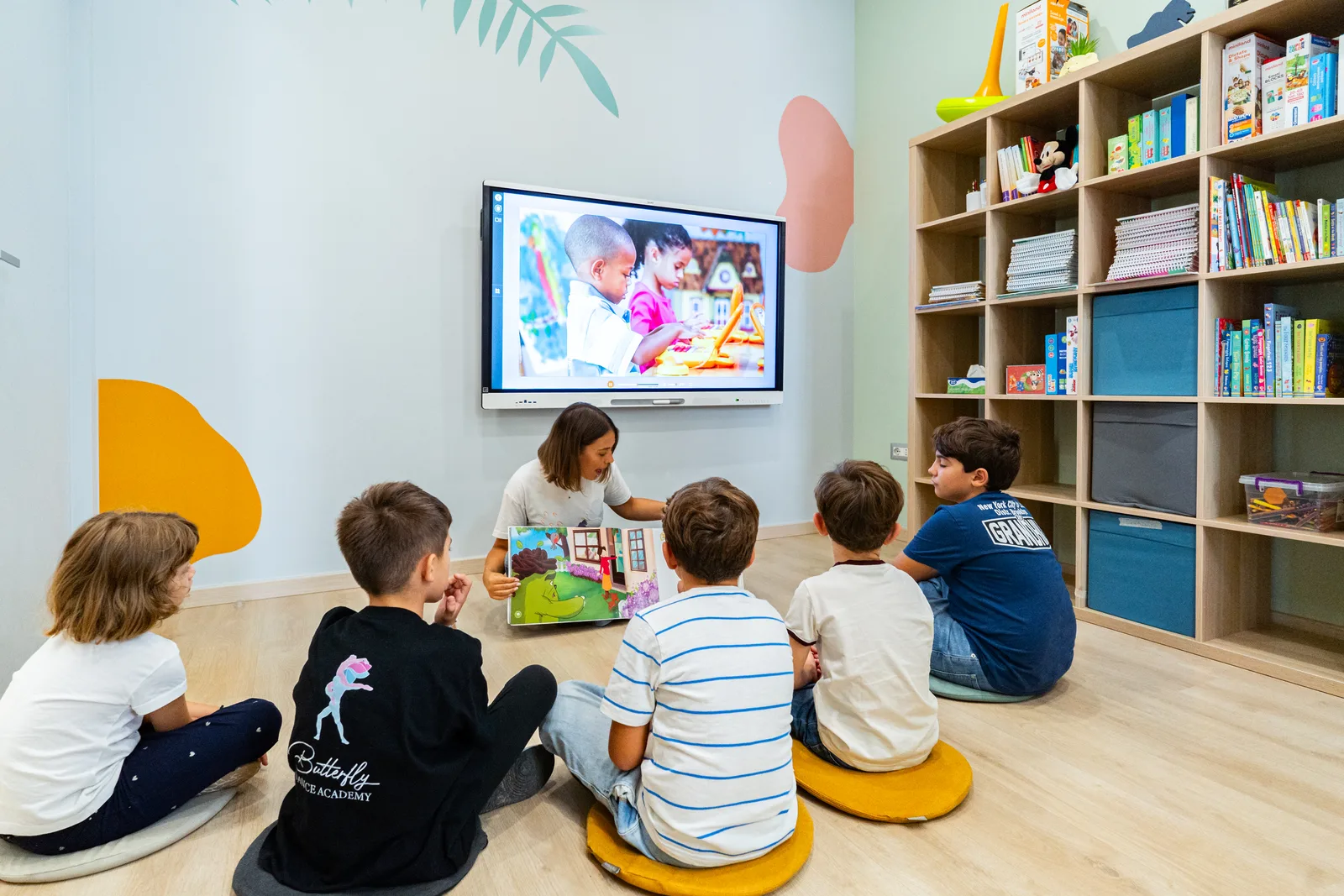
Sixty minutes with children the same age, in groups of up to 6, with teachers who are only native speakers or perfectly bilingual. The topic of the week comes back in different forms, with activities changing roughly every 15 minutes: an interactive whiteboard game, a game between classmates, the Cambridge book, a dance, a song. Changing the pace keeps attention high and brings the same language back again and again, without ever getting tiring. With up to 6 children, everyone speaks, every session: every child is visible.
The Creative Lab
The second session is an English-language creative workshop with mixed ages: up to 16 children with two native-speaker teachers. Yoga, gardening, cooking, art, festivals from around the world such as Diwali or Chinese New Year: English becomes the means for doing lovely things together. The youngest watch the oldest and try to do the same, each in their own way. The Creative Lab is an integral part of the pathway, not an occasional event.
Junior and Teens: LANGUAGE LAB and SPEAK UP, 120 minutes
For Junior (11–13 years) and Teens (14–18 years), the week includes two weekly 60-minute sessions (120 minutes): LANGUAGE LAB — building the language and SPEAK UP — using the language. In groups of up to 6, students build grammar and vocabulary in practical contexts and use English for conversation, pair and group activities, problem solving and Cambridge preparation.
And KOKO Babies?
For the youngest children, aged 1 and 2, we chose a different measure: one 45-minute session a week with a parent in the classroom, plus two sensory labs a month. At that age, the session in class is the starting point: songs and gestures go home with mum and dad, and that’s where exposure continues every day.
Why we can do this
KOKOland is an independent school, not a franchise: we don’t pay royalties or fees to a brand. What would go to a network elsewhere, we reinvest in the pathway: in the evolution of the method, year after year, in the classrooms, in training and in native-speaker teachers. A lean school can give children more English.
How to stretch the week further, even at home
- Small moments, every day. A song in the car, a story before bed: even a few minutes help, if they happen regularly.
- Let them teach you. Ask the children for the song or word of the week: explaining it to mum and dad is a way of repeating it with pride.
- Summer in English. From ages 4 to 12, KokoCamp brings English outdoors, at Casale dei Pini.
Frequently asked questions
How many hours of English a week does a child need?
There’s no single number that works for everyone: research shows that what matters is the quantity and quality of exposure — how much real English a child hears and uses, with how many people, and for how many years. At KOKOland, from ages 3 to 10, children have 120 minutes a week, split between the dynamic learning session and the Creative Lab; from 11 to 18, with Junior and Teens, 120 minutes of LANGUAGE LAB and SPEAK UP.
How many hours a day should you study English?
For children, it’s less about hours of study and more about daily contact: small moments every day, like a song or a story read together, keep the weekly sessions alive. The same principle applies to teenagers: aim for regularity, week after week and year after year, with real chances to use English.
Is one hour of English a week enough?
One session a week can build a good relationship with English and the first foundations, but real growth needs more hours and more chances to speak. Research on bilingualism reminds us that exposure concentrated into just one moment a week, on its own, isn’t enough. That’s why, from age 3 up, KOKOland offers two sessions a week.
Come and meet us in person
The best way to understand how we use every minute is to see it for yourself. At Demo Day, our free, roughly 30-minute open day, children experience the rhythm of dynamic learning in a small group their own age, in Martina Franca or Monopoli. Details for every age group are on the pathways from 1 to 18 page, including KOKO Babies for 1 and 2-year-olds.
Sources
- Muñoz (2014), Contrasting Effects of Starting Age and Input on the Oral Performance of Foreign Language Learners, Applied Linguistics
- Place, Hoff (2011), Properties of Dual Language Exposure that Influence Two-Year-Olds’ Bilingual Proficiency, Child Development
- Kuhl, Tsao, Liu (2003), Foreign-language experience in infancy, PNAS
- Byers-Heinlein, Lew-Williams (2013), Bilingualism in the Early Years: What the Science Says, LEARNing Landscapes
- Eurydice (European Commission), Italy: teaching and learning in primary education
- INVALSI, 2026 INVALSI test report (regional English-language data)
Keep reading
Free Demo Day
Try a free Demo Day.
A dynamic learning activity in English, in a small group of children their own age, with the teaching team.