
Halloween games in English: 5 easy games to play at home in five minutes
19 October 202611 min read

In brief
- Five Halloween games in English to play at home with children aged 3 to 12. It is the gentlest kind of Halloween: greedy monsters, little ghosts and sweets.
- Each one takes about five minutes to set up, with things you already have at home and the printable cards.
- Beside every English phrase there is a button: tap it to hear the pronunciation. Three phrases are enough to start.
- The cards for all five games, eight pages as a PDF, are at the end of the article.
Halloween words are few and concrete, and children enjoy learning them: the pumpkin, the little ghost, the bat, the black cat. That makes Halloween week a lovely moment to bring a little English into the house, through play. Here are five Halloween games in English for children aged 3 to 12, all set up with things you already have at home. Beside every English phrase you will find a button: tap it, listen to the British voice and repeat the phrase together. If you get the pronunciation wrong, never mind; children love correcting grown-ups.
Three phrases are all you need
- passes the game to the next player
- for every try, right or wrong
- when everyone wants another go
They work with all five games. Tap a button to hear the voice and repeat it straight away; these are the phrases you will use again and again in the first few days.
How to play in English at home, with a child-sized Halloween
At home, your role is the playmate. The English words come back every day inside a game that is fun, and repetition does the rest of the work. Three habits help a lot:
- Five minutes a day. A few minutes every day are worth more than one long afternoon. A good moment is after the snack or just before bath time.
- The same game for a week. Children love finding a game they already know, and every repetition makes them more confident; often, by the third day, they are saying the phrases on their own.
- If a child answers in Italian, that is fine too. Say the word again in English, in a light tone, and carry on. Children understand long before they speak, as we explain in our article on the silent period.
Our Halloween is the Halloween of smiling greedy monsters, pumpkins and sweets. You can dim the lights, but leave out the pitch darkness; and if a game frightens anyone, change it straight away.
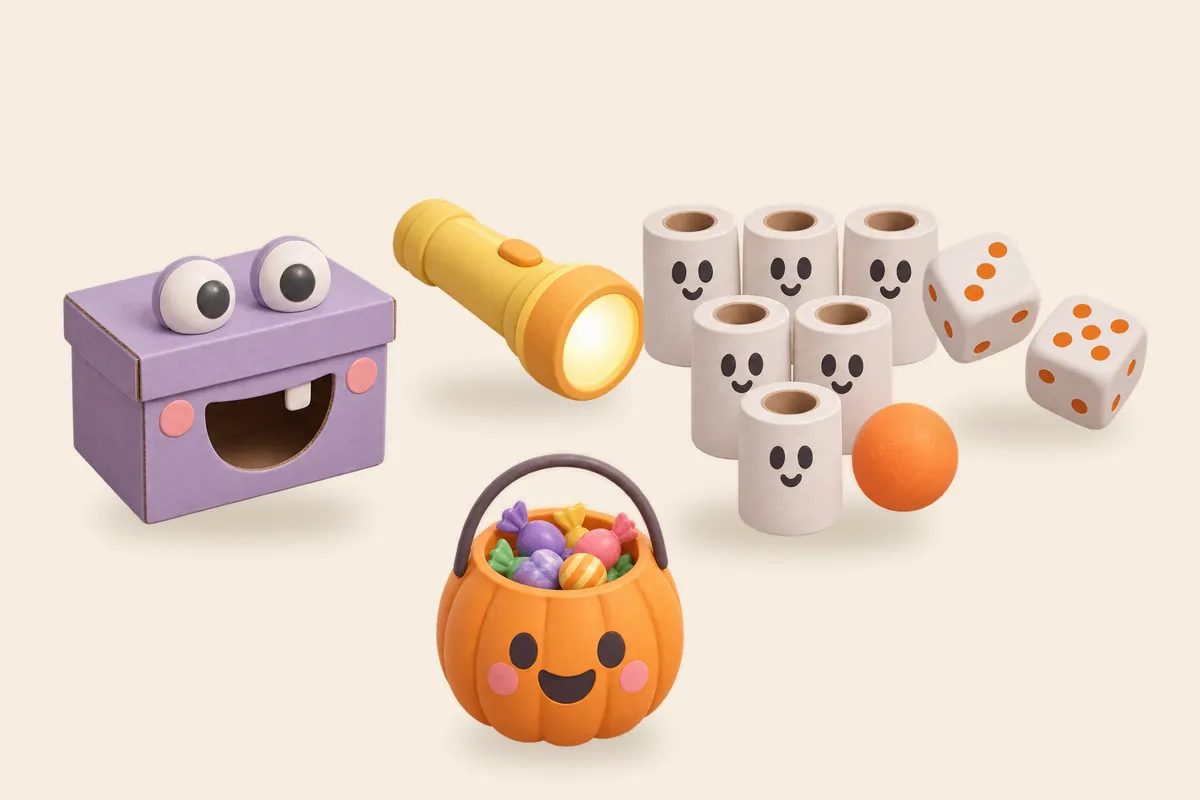
The 5 Halloween games in English, one by one
1. Feed the monster! (the greedy monster) · ages 3–6
You will need: a box and the cards from the PDF. A shoebox is fine; the PDF has the monster’s face to stick on and eight food cards, from an apple to a cake.
How to play:
- Stick the face on the box and cut out the mouth.
- The monster says “I’m hungry!” and a card is picked.
- The child says the name of the food in English and feeds it to the monster.
The monster’s voice is yours: announce that it is hungry and wait, mouth wide open. If the request comes with a “please”, even better: the card disappears into the mouth and the monster says a contented “Yum, yum!”. An adult cuts the mouth out of the cardboard.
The English words:
- the monster’s opening line
- the child’s request, with the magic word
- the monster’s thank-you
On the cards:
A touch of wow: Lend the monster a funny deep voice. At the end of the game, open the lid: inside there is a sweet for whoever fed it.
Tip by age: at 3, three or four cards are plenty, always the same ones. If the child says only the name of the food, you complete the sentence with the “please”. At 5 and 6 the roles swap: they play the monster with the deep voice, and you do the feeding.
2. Ghost hunt (a torch hunt for little ghosts) · ages 3–8
You will need: the ghosts from the PDF and a torch. There are ten numbered ghosts to cut out; the torch on a phone works perfectly well.
How to play:
- Hide the ghosts in a room.
- Dim the lights and switch on the torch.
- Count every ghost you find in English.
Torch in hand, the child goes hunting and asks where the ghost is. When the beam of light uncovers one, you count it together, up to ten. Older children add where they found it, for example under the table or behind the sofa.
The English words:
- the hunter’s question as the torch sweeps the room
- shouted when a ghost is caught in the light
- a hiding place, to say where it was
On the cards: ·
A touch of wow: Every time the torch finds a ghost, everyone shouts “I found it!” together. For the youngest, leave a small light on.
Tip by age: at 3 and 4, hide the ghosts almost in plain sight and count aloud yourself while the child collects them. From 6, for every ghost found, ask where it was; the position words printed on the cards are there to help with the answer.
3. Ghost bowling (bowling with little ghosts) · ages 4–10
You will need: 6 toilet rolls and a ball. In the PDF you will find the six ghost faces to stick on the rolls and the sheet for keeping score.
How to play:
- Stick on the faces from the PDF and stand the rolls in a triangle.
- Roll the ball and count the ghosts that fall.
- Write the score on the sheet; if they all fall, it is a “Strike!”.
Before every throw, everyone says “ready, steady, go” together, in English. The fallen ghosts are counted aloud, and the score goes on the sheet, turn after turn.
The English words:
- said together before every throw
- the count after a throw
- when every ghost falls
A touch of wow: With the lights low, use water bottles with a ghost face instead of the rolls, and a glow stick inside each one: the skittles light up in the half-dark. The glow stick always stays sealed inside the bottle, and an adult prepares it.
Tip by age: at 4 and 5, move the skittles closer and count the fallen ghosts with the child, one at a time, using the same numbers as in Ghost hunt. From 8, everyone keeps their own score for three turns and the highest total wins; the total, of course, is announced in English.
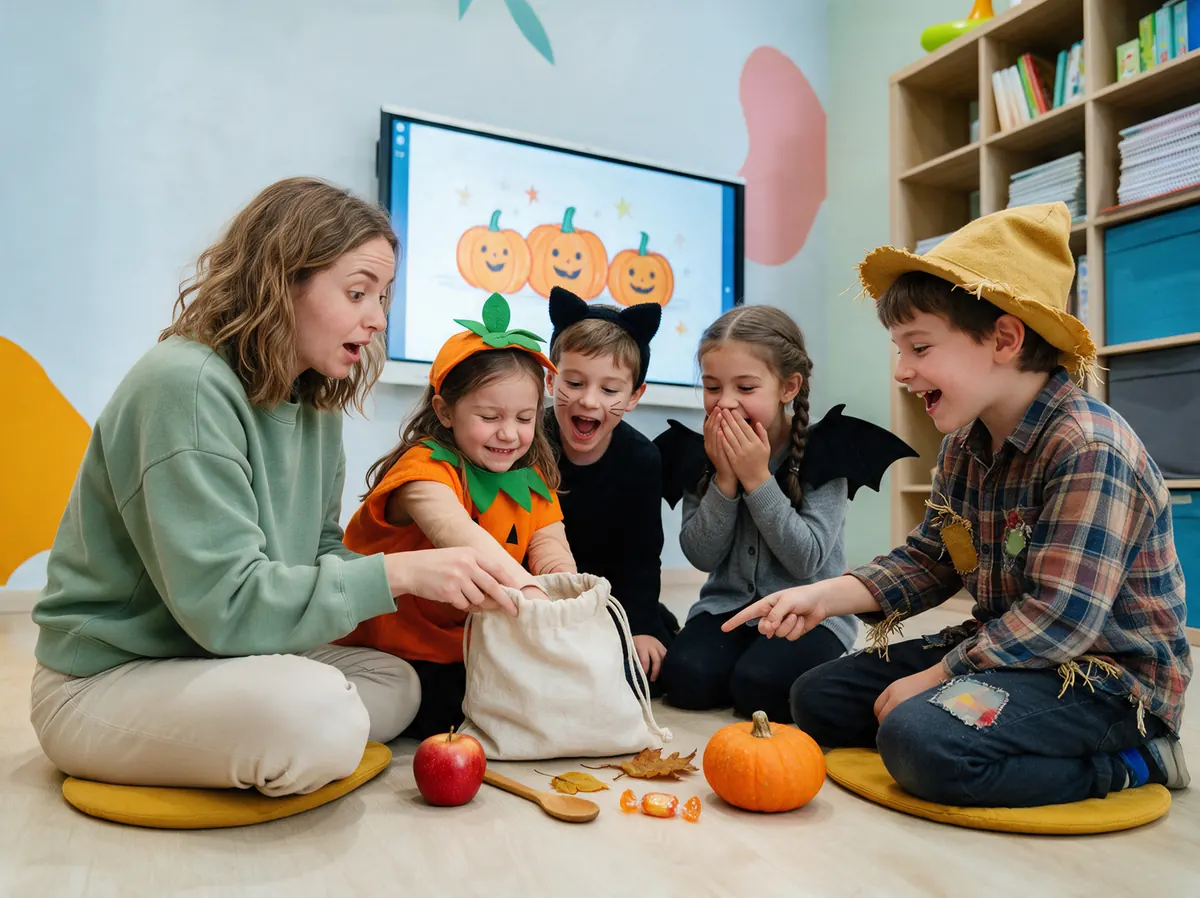
4. Roll a monster (the dice monster) · ages 6–10
You will need: a dice, the sheet from the PDF and pencils. The sheet has a table with one row for each part of the monster, and space below to draw it.
How to play:
- Roll the dice: the sheet tells you what to draw.
- Roll once each for the eyes, arms, legs, mouth and hair.
- Give the monster a name and introduce it in English.
Row after row, the dice decides: if a four comes up on the eyes row, the monster will have four eyes. When the drawing is done, you complete the sentence at the bottom of the sheet, choose a name and present the monster to the whole family.
The English words:
- the signal for the next throw
- the dice result, said as the drawing begins
- the proud introduction at the end
On the cards:
A touch of wow: With the same numbers, everyone draws a different monster. Hang them all on the fridge, and the family’s monster exhibition is ready.
Tip by age: at 6 and 7 it is enough to say the number and the body part while drawing. From 8 to 10, the monster is described with the full sentence and the listener draws it without seeing it; comparing the two monsters at the end always brings a few laughs.
5. Trick or treat! (door to door) · ages 7–12
You will need: the cards from the PDF and a basket of sweets. The PDF has two signs to hang on door handles, the question cards, ready-made answers for the costumes and eight “trick” cards with challenges.
How to play:
- Hang the signs on the handles of the doors at home.
- Knock, saying “Trick or treat!”, and the question comes from behind the door: “What are you?”
- Whoever answers in English gets a sweet; whoever cannot first takes on a “trick” challenge.
The visitor greets with the Halloween phrase; whoever opens the door replies with a question in English, taken from the cards. If the answer comes, the sweet is earned. If it does not, a “trick” card is picked and the challenge is taken on, after which the sweet arrives anyway: at Halloween nobody goes home empty-handed.
The English words:
- the greeting at the door
- the question from behind the door
- an answer, in costume
On the cards: · ·
A touch of wow: The grown-ups play the homeowners and the little ones knock in costume. The challenges are funny on purpose, like “Dance like a ghost!”.
Tip by age: at 7 and 8, one question per door is enough, always the same one. From 10 to 12 they are the homeowners: they choose the questions from the cards, read them aloud and decide the challenge. It works particularly well with brothers, sisters and cousins of different ages, because everyone finds their own role.
Halloween words in English, with the pronunciation
These words come up in all five games; tap a button to hear them. Children may like to know that sweets are called “sweets” in the United Kingdom and “candy” in the United States.
| Word | Where you will meet it |
|---|---|
| “I’m a pumpkin!” in Trick or treat! | |
| the little ghosts in Ghost hunt and Ghost bowling | |
| Feed the monster! and Roll a monster | |
| “I’m a bat!” and “Fly like a bat!” | |
| a classic Halloween costume | |
| the treats at the end of Trick or treat! | |
| what you wear to knock on the door | |
| what children say at the door | |
| the greeting on 31 October |
In English-speaking countries, on Halloween night, children go from door to door saying “Trick or treat!” and are given sweets.
Which game to choose by age
| Game | Age | What it practises |
|---|---|---|
| Feed the monster! | 3–6 | food, “please” |
| Ghost hunt | 3–8 | numbers, position words |
| Ghost bowling | 4–10 | numbers, scores |
| Roll a monster | 6–10 | body parts, numbers, introducing |
| Trick or treat! | 7–12 | questions and answers, costumes |
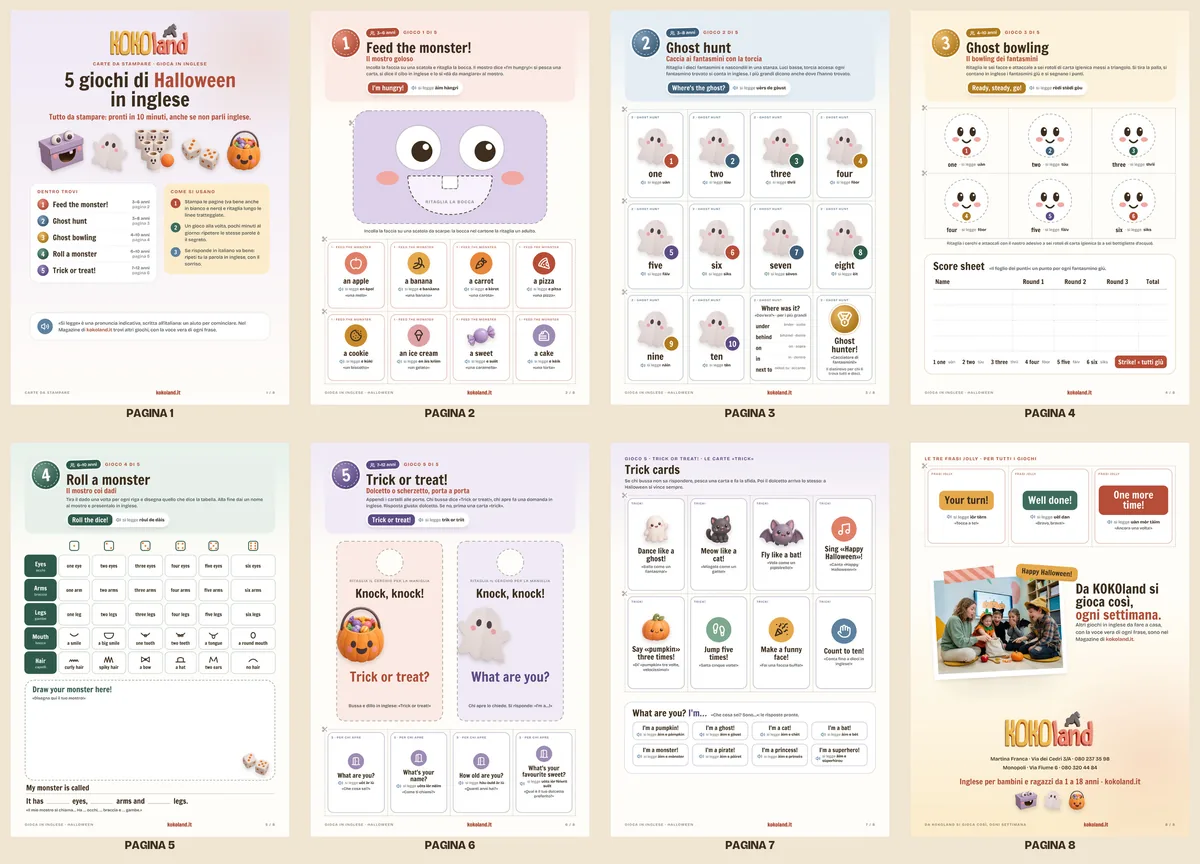
Once printed, cut the cards out along the dotted lines and choose the game to start with: they will keep you company all through Halloween week.
Download the printable cards for the 5 Halloween games (PDF)
Mistakes to avoid
- Turning the game into a test. A question like “How do you say pumpkin?” kills the enthusiasm in an instant. A word sticks when it is needed to play, for example to feed the monster.
- Correcting every mistake. When a child gets something wrong, repeat the correct form yourself, naturally, and let the game go on.
- Making Halloween scary. A frightened child stops playing, and when the play stops, so does the English. With the youngest, greedy monsters and smiling little ghosts work far better than skeletons and witches.
Frequently asked questions
Which Halloween games in English can you play with children at home?
With the youngest, aged 3 to 6, Feed the monster works well: a greedy monster to feed with the food cards. Ghost hunt, the torch hunt for little ghosts, suits ages 3 to 8; Ghost bowling, bowling with toilet rolls, ages 4 to 10. Roll a monster, the monster drawn with a dice, is right for ages 6 to 10, while Trick or treat, door to door, is meant for the oldest, aged 7 to 12. All you need are things from around the house and the printable cards.
What does “Trick or treat!” mean?
It is what children in English-speaking countries say when they knock on doors on Halloween night: give us a treat, or we play a trick. To wish someone a good Halloween, you say “Happy Halloween!”.
Can children play these games without knowing any English?
Yes. Teach two or three phrases at a time, tap the button beside each one to hear how it sounds, and use them again and again in the same games. If a child starts saying them before you do, the game is working.
From what age can children play Halloween games in English?
You can start at 3, with movement and object games and one or two words at a time: the greedy monster and the ghost hunt are designed for that age. From 7 upwards, games made of questions and answers with whole sentences work well, like door-to-door Trick or treat.
The game goes on in class
At KOKOland, children learn English like this all year round, playing in small groups of up to 6 peers, with native or bilingual teachers. The activities change about every 15 minutes and alternate songs, stories and team games. Enrolled families carry on at home with KOKO Play, our educational game in English. You will find us in Martina Franca and Monopoli, with a path that accompanies children and teens from 1 to 18.
For the rest of the year, from Simon says to the colour hunt, you will find more ideas in English games for children: 12 ideas to play at home; and for December, Christmas in English for children is waiting for you.
And if you would like to see how English is played in a real classroom, we look forward to seeing you at our free Demo Day, together with children of the same age.
Keep reading
Free Demo Day
Book a free Demo Day.
A real, free lesson in a KOKOland class of children the same age. You stay at the school and we explain the method.