
Silent period: a child understands English but doesn’t speak it. What to do
12 October 202610 min read

In short
- The silent period is the stage when a child understands English but doesn’t speak it yet: they listen, watch and answer with gestures. It is common and, in itself, not a sign of delay.
- The length varies a great deal from child to child: for those immersed in the language every day, researchers talk about a few months, up to about six.
- What helps: questions that can be answered with a gesture, small groups, songs and games. What doesn’t: asking a child to “say it in English” in front of others.
- If a child speaks little in Italian too, or the silence appears everywhere, the first point of contact is the paediatrician.
The silent period is the stage when a child learning a new language understands it but doesn’t speak it yet. In an English class it often happens in the first few weeks: the child follows everything, laughs at the teacher’s jokes, points to the right picture, but when asked a question answers with a smile, in Italian or with nothing at all. At home, asked “what did you do today?”, they won’t say a single word in English. For many parents this is the moment of doubt: are they really learning? In the great majority of cases the answer is yes. Here is why, how long it can last, what to do and what to avoid, and which signs call for a word with the paediatrician.
What is the silent period?
The linguist Stephen Krashen described it in the early 1980s: children who learn a second language naturally may say very little for a few months while they build the language by listening and understanding what goes on around them. According to Krashen, the ability to speak emerges on its own once enough has been understood.
The American researcher Patton Tabors, observing young children in settings where a new language was spoken, identified four stages that come up again and again:
- Home language. At first the child keeps using their own language, expecting to be understood.
- The non-verbal period. They realise that another language is needed and stop talking for a while: they watch, listen, communicate with gestures and sometimes repeat sounds under their breath.
- First words “in public”. Single words and ready-made phrases learned by heart appear: “my turn”, “bye bye”, the chorus of a song.
- A growing language. The child combines the pieces they know and builds sentences that are more and more their own.
Many researchers prefer to speak of a “non-verbal” period precisely because the child is not absent at all: they take part with their eyes, their gestures, their whole body. Two English researchers, Caroline Bligh and Rose Drury (Journal of Research in Childhood Education, 2015), describe it as an active time, in which the child learns in their own way. And Rose Drury tells an episode that says it all: a 4-year-old girl, who during a group game about parts of the body took part almost only with gestures, was found shortly afterwards humming “knees and toes, knees and toes” all by herself. The language was already there: it was waiting for the right moment to come out.

Does it happen to children who learn English in class, not only to bilingual children?
Yes, although in a different form. Almost everything you read online is about children who grow up with two languages at home, or who move to a foreign country. A child in Italy who goes to an English course twice a week has far fewer hours of exposure, and their silence usually shows up at two moments: in the first weeks in a new group, and at home, when they are asked to “say something in English”.
Krashen already noted that at school children rarely get the time for a silent period, because they are asked to speak straight away. But there is another side to the coin. A review by Theresa Roberts (Early Childhood Research Quarterly, 2014) concluded that the evidence for a silent period that is the same for everyone is weaker than people think, and that the way adults invite and support a child can lengthen or shorten the silence. In practice: silence deserves respect, but it should not be left to itself. Children need regular, light opportunities to take part.
How long does the silent period last?
There is no standard length: it varies from one child to another, and some do not go through it at all, as the Leaders Project at Teachers College, Columbia University, points out. For children immersed in the new language every day, Krashen speaks of a few months, up to about six. With two classes a week exposure is lower, so it is reasonable to expect different timings. Rather than counting weeks, it is better to look for signs of progress.
| Stage | What you may notice | What you can do |
|---|---|---|
| Listening | follows the activities, copies gestures, answers in Italian to questions asked in English | keep speaking English to them even without an answer, and accept gestures as answers |
| Trying out under their breath | hums the songs alone, repeats words while playing, “plays teacher” with soft toys | don’t interrupt and don’t point it out: let them play |
| First words | says single words and ready-made phrases: colours, numbers, “my turn”, “thank you” | celebrate the attempt, not the perfection; repeat the complete phrase |
| Their own sentences | combines words, asks questions, tries to tell a story | give them time to finish and ask open questions |
What to do (and what not to do) when a child won’t speak
The educator Priscilla Clarke collected a few strategies to support children at this stage, still used today in teacher training in England: keep talking even when the child doesn’t answer, involve them in small groups, accept non-verbal answers, praise even the smallest attempt, and offer role play. Here is how they become everyday gestures.
| Yes | No |
|---|---|
| Questions answered with a gesture or a word: “point to…”, “which of the two?” | “Tell me how you say…”, as if it were an oral exam |
| Repeat in English what they said in Italian, naturally | Correct every word or ask them to repeat |
| Songs, rhymes, games with the same phrases every time | Asking them to “say something in English” in front of grandparents and friends |
| Praise the effort: “you understood everything!” | Comparing them with brothers, sisters, cousins or classmates |
| Give the journey time and continuity | Calling them “shy” in front of them, or stopping the course at the first silence |
If you would like to try at home in English, these questions can be answered without speaking. Tap them to hear the pronunciation:
- “Can you show me?”: the answer is to show.
- “Point to the dog!”: it works with a picture book or with toys.
- “Is it big or small?”: choosing between two words is the first step towards saying one.
- “Thumbs up or thumbs down?”: a way to say whether they like something, without words.
- “High five!”: to celebrate every attempt.
More ideas for bringing English back into the home, five minutes a day, are in our English games to play at home.
How a KOKOland class welcomes the silent period
Our method, dynamic learning, is built so that children can take part long before they speak. Here is how, in practice.
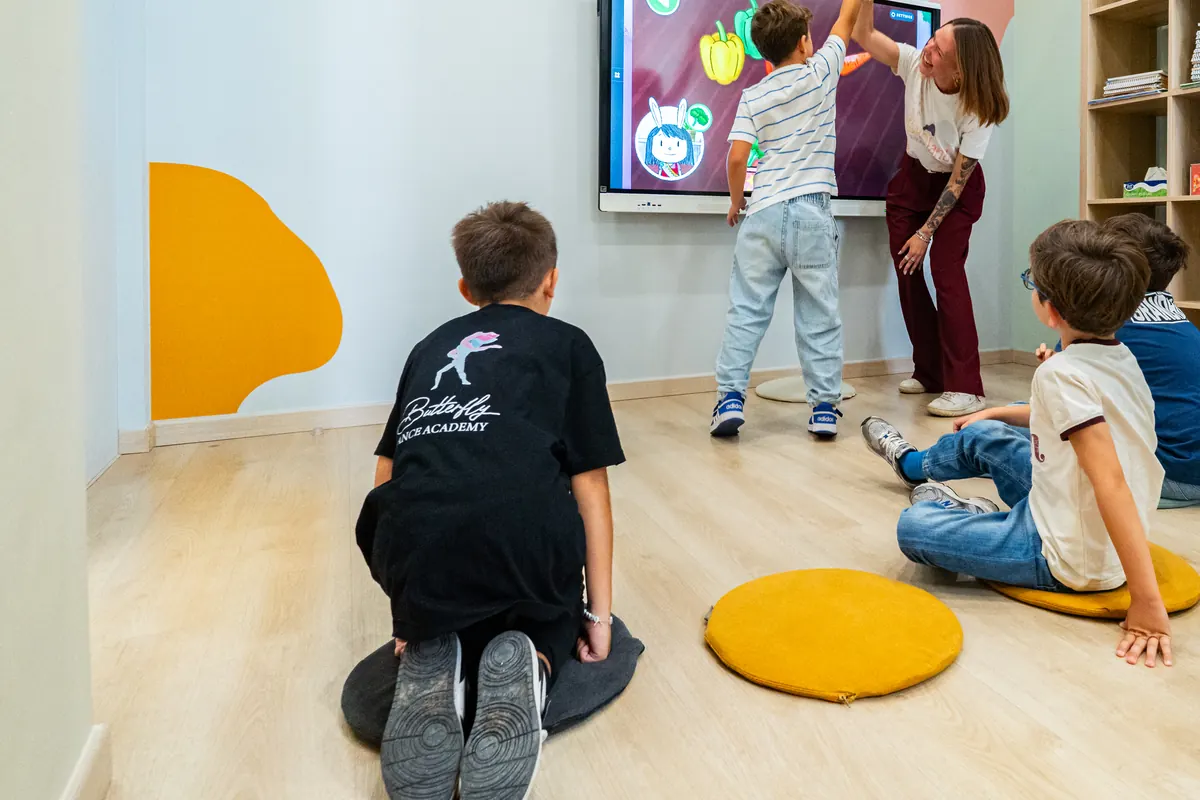
- Groups of up to 6 children of the same age. In a small group nobody hides and nobody feels exposed: every child has space, and is heard even when they answer with a gesture.
- A different activity about every 15 minutes. Song and movement, an interactive whiteboard game, a story from the book, a team game: the same words come back four times in different forms. Singing with gestures, touching and dragging pictures on the whiteboard, pointing to a picture are already ways of answering in English.
- Role play. In the market during the week on food, the phrase “Can I have an apple, please?” is used to get something: that is often where the first ready-made phrases arrive.
- The mixed-age Creative Lab. In the second class of the week the youngest watch the older ones and try to do the same, each at their own level.
- Native or bilingual teachers, who speak English naturally even when the answer comes in Italian.
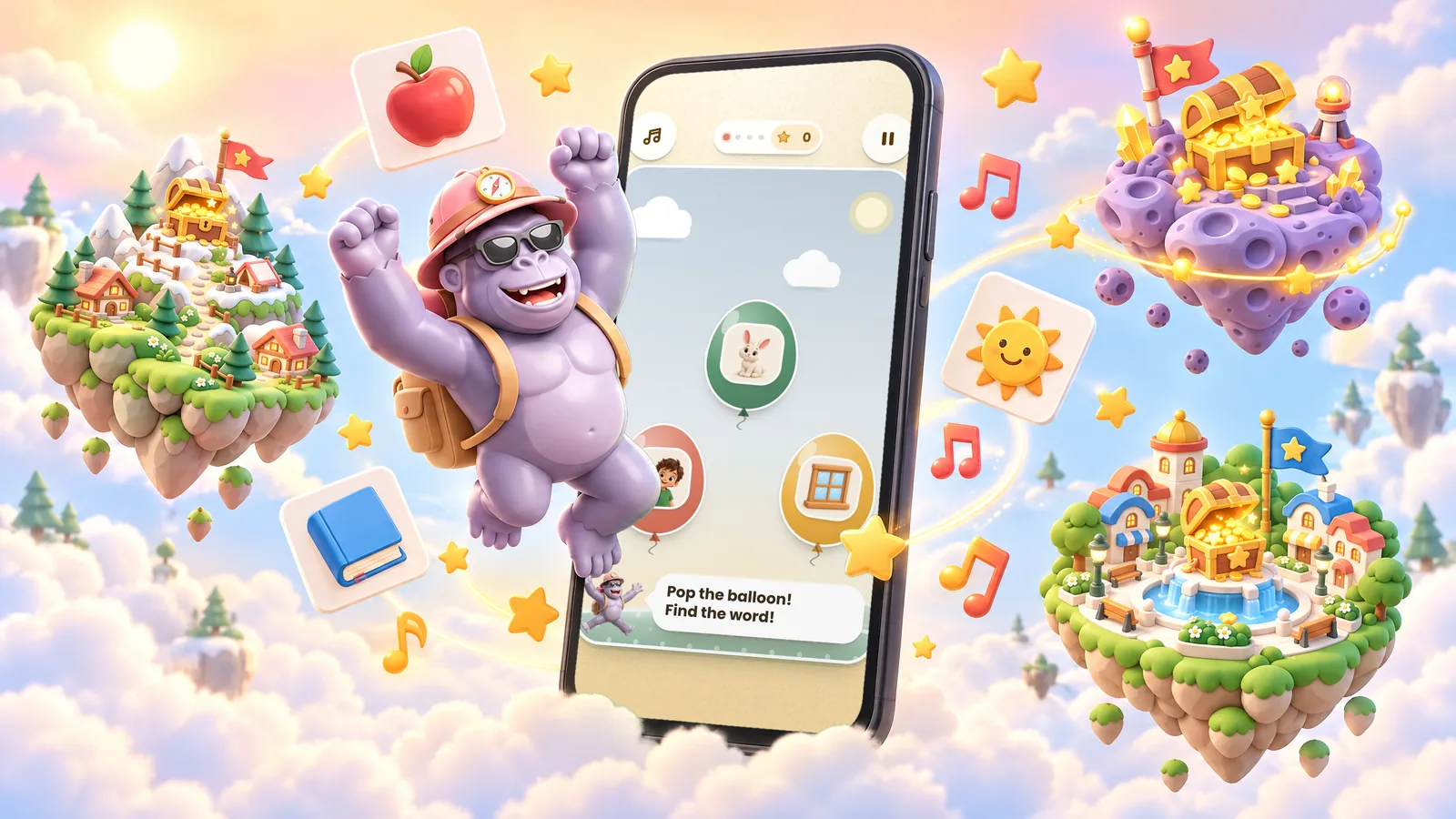
At home there is one more ally. In KOKO Play, KOKOland’s educational game, the voice games let children answer Koko out loud: for a child who prefers to listen in a group, talking to Koko with nobody watching is often a first step. You manage the microphone from the profile, and the voice is neither saved nor sent. We tell the story in KOKO Play, the app for learning English born in a school.
When to talk to the paediatrician or a speech and language therapist
The silent period concerns the new language. Talk to the paediatrician, who will be able to tell you whether a speech and language therapist or a child neuropsychiatrist is needed, if you notice one or more of these signs:
- a child speaks little or nothing even in Italian, at home and with people they trust;
- they struggle to understand simple instructions even in Italian, or you have doubts about their hearing;
- the silence is not only about English: they don’t speak at school, with grandparents or with friends, and they stiffen or freeze when speaking is expected;
- they have suddenly stopped speaking in places where they used to speak;
- the distress is strong and lasting: they cry, don’t want to go in, seem frightened.
These are signs reported by the UK’s National Health Service (NHS) and the Bambino Gesù Paediatric Hospital. This article is not a substitute for a professional opinion: if in doubt, always ask the paediatrician.
Can bilingualism cause a language delay?
No. According to the Bambino Gesù Paediatric Hospital, a child exposed to two languages generally goes through the same stages as monolingual peers: sometimes first words or answers come a little later, but this is not a true delay, and if a language disorder is present, bilingualism is not its cause. We have put other common beliefs to the test of research in our article on the myths about early bilingualism.
Test yourself
Frequently asked questions
What is the silent period?
It is the stage when a child learning a new language listens, understands and takes part with gestures, but doesn’t speak it yet. Linguists such as Stephen Krashen and Patton Tabors have described it: it is common in children and is not, in itself, a sign of delay.
How long does the silent period last?
It varies a great deal from child to child. For children immersed in the new language every day, Krashen speaks of a few months, up to about six; with two classes a week exposure is lower, so timings may differ. More than the days, what counts is seeing that the child understands more and more.
Can bilingualism cause a language delay?
No. According to the Bambino Gesù Paediatric Hospital, children exposed to two languages generally go through the same stages as monolingual children; sometimes first words come a little later, but this is not a true delay, and bilingualism does not cause language disorders.
What should I do if a child doesn’t want to speak English?
Keep speaking English to them even without an answer, ask questions that can be answered with a gesture or a single word, praise every small attempt and play. Avoid asking them to “say something in English” in front of others.
Can a shy child learn English?
Yes. Many shy children listen with great attention and, when they start to speak, they do so in sentences that are already complete. Small groups, repeated routines and activities where you can take part without words, such as songs with gestures and interactive whiteboard games, all help.
When should I talk to the paediatrician or a speech and language therapist?
If a child speaks little or nothing in Italian too, if they struggle to understand simple instructions, if the silence extends to school, relatives and friends, or if they have stopped speaking where they used to speak. The first point of contact is the paediatrician.
Come and see it in class
The best way to understand how a child moves from listening to first words is to see it happen. At Demo Day, the free session inside a real KOKOland class with children of the same age, you can see how children take part even without speaking and ask us anything you like. For the youngest, start with KOKO Stars, ages 3 to 6. Send us a request: we will reply.
Sources
- Krashen (1982), full text on the author’s website, chapter on the input hypothesis and the silent period
- NALDIC, Stages of early bilingual learning (Tabors’ stages, 1997; Clarke’s strategies, 1992; Drury’s observations, 2007)
- Bligh, Drury (2015), Perspectives on the “Silent Period” for Emergent Bilinguals in England, Journal of Research in Childhood Education
- Roberts (2014), Not so silent after all: Examination and analysis of the silent stage in childhood second language acquisition, Early Childhood Research Quarterly
- Leaders Project, Teachers College, Columbia University, Silent period
- Bambino Gesù Paediatric Hospital, Bilinguismo: quando in famiglia si parlano due lingue (Bilingualism: when a family speaks two languages)
- NHS, Selective mutism
Keep reading
Free Demo Day
Book a free Demo Day.
A real, free lesson in a KOKOland class of children the same age. You stay at the school and we explain the method.