
English games for children at home: 12 ideas for 5 minutes a day
11 October 202610 min read
In short
- The most effective English games to play at home are simple and repeatable: Simon says, the mystery bag, the shop, I spy.
- You don’t need to be a teacher: every phrase in this article has a button with the correct pronunciation, and three phrases are enough to start.
- The method is 5 minutes a day, every day, with the same game for a whole week.
- You’ll find 12 games grouped by age (3–5, 6–8, 9–12 years) and printable cards.
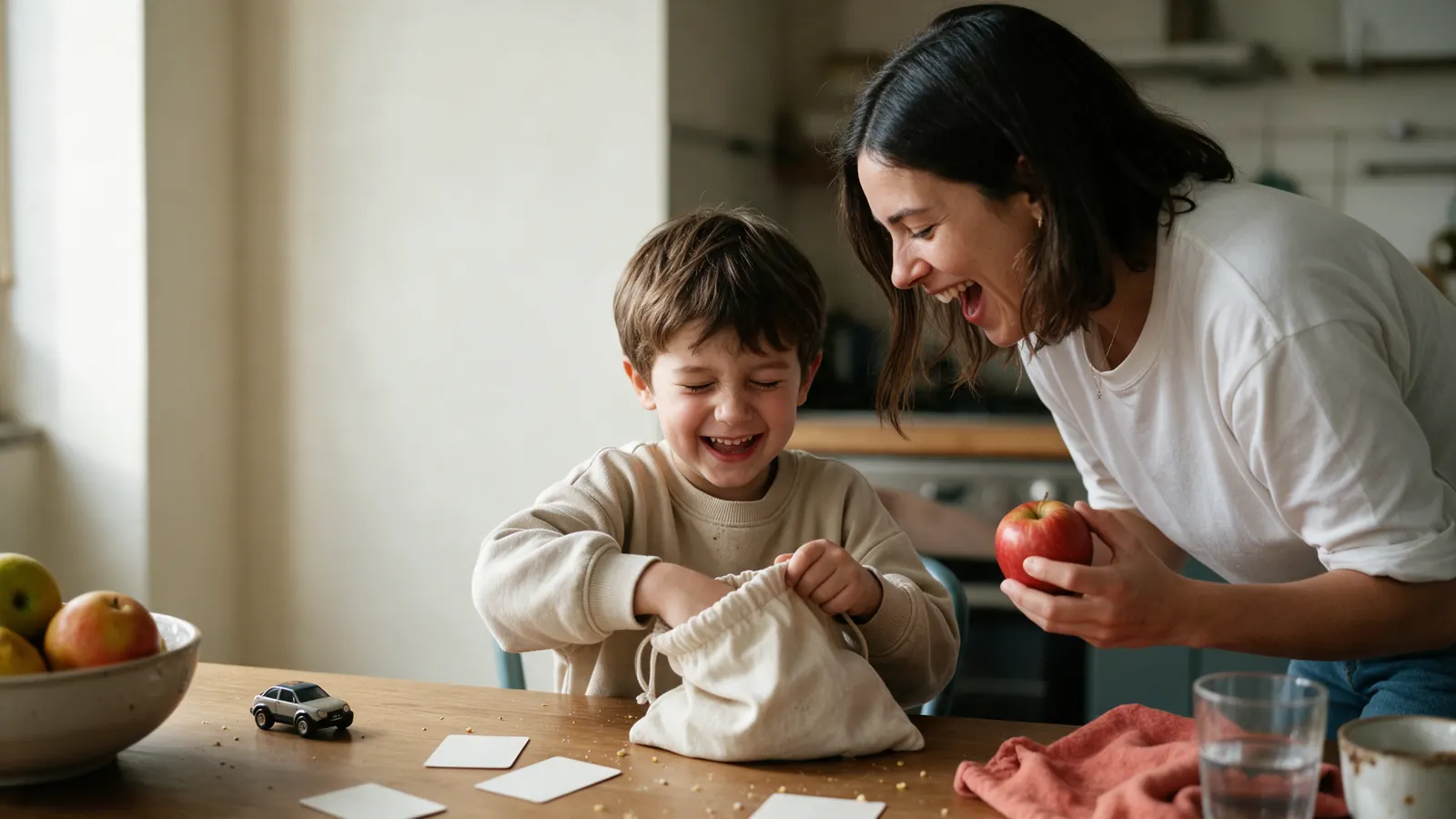
English games for children work at home when they are short, repeated and fun: Simon says, the mystery bag, the shop, hot and cold. They need no special materials and no perfect English. They need just one thing: playing often. Here you’ll find twelve games grouped by age, with the materials, the rules and a script for the grown-up. Every English phrase has its own button: tap it, listen to the pronunciation of a native British voice and repeat it together. That way a child hears the sentences said properly, and you can play along with confidence even if English was never your strong point.
Three phrases that are enough to start
- to pass the turn in any game.
- after every attempt, even a wrong one.
- to repeat, which is the real secret.
Tap the button, listen, repeat. With these three phrases you can already play all twelve games below.
How can you help children with English at home?
At home you don’t have to be the teacher, you have to be the playmate. Real teaching belongs to people who speak English as a native or bilingual speaker: in a study of children of about 2 years old (Place and Hoff, Child Development, 2011), skills grew with the share of English heard from native speakers and with the number of different people they heard it from. At home, your job is simply to bring those words back every day, inside a game.
Research on learning points to four ingredients that make the difference: a child needs to be active (choosing, moving, answering), engaged without distractions, working on something that makes sense to them, and in a relationship with someone (Hirsh-Pasek and colleagues, 2015). A game with mum or dad has all four. And if you get a word wrong? That’s perfectly fine: when a child corrects you, they are really using English, and they feel grown up.
The 5-minutes-a-day method
Five minutes every day beat an hour once a week. A synthesis of hundreds of memory experiments (Cepeda and colleagues, 2006) confirms that short, spaced-out practice fixes words better than one long session. In practice:
- Same time, every day. After snack time or in the car: a small ritual.
- One game per week. Repetition doesn’t bore children, it makes them confident.
- Two or three phrases at a time. First you listen to them on the button, then you use them the same way every time.
- Stop while it’s still fun. It’s better to finish when a child is asking for “again!” than when they are tired.
- Swap roles. After a few days the child leads the game and says the phrases: that is the moment English moves from listening to speaking.
English games for children aged 3, 4 and 5
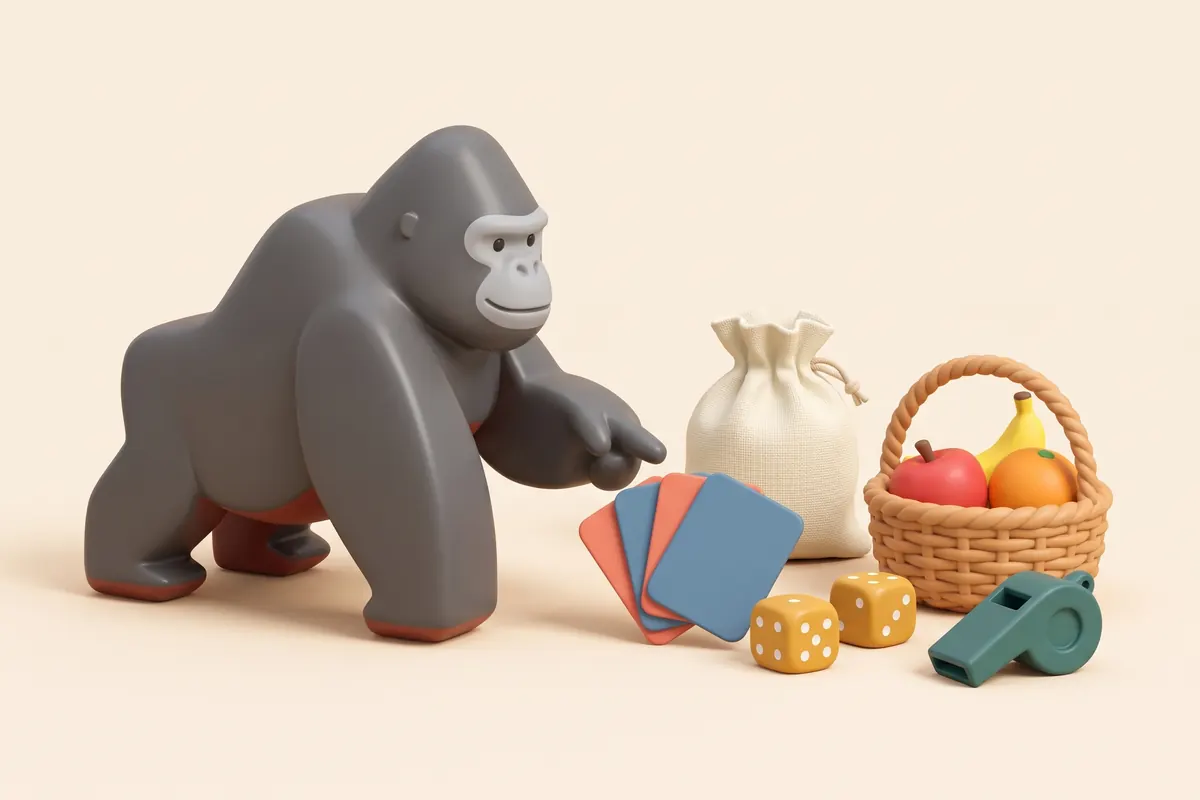
At this age children learn with their body and with objects. If a child answers with a gesture, the game is working: don’t ask them to repeat, give them the example.
1. Simon says
Materials: none.
How to play: give an order: the child does it only if the sentence begins with “Simon says”. If you don’t say it and they move anyway, everyone laughs and you start again. Then the child becomes Simon.
The phrases to use:
The trick: it’s the perfect game for beginners: children understand English through movement, without having to speak yet. It is the idea behind the Total Physical Response method, described by James Asher in 1969.
2. Colour hunt
Materials: things around the house.
How to play: say a colour and the child runs to touch something of that colour. Then it’s their turn to choose the colour and you run.
The phrases to use:
3. Mystery bag
Materials: a cloth bag and 4 or 5 objects the child knows (a ball, an apple, a toy car, a spoon).
How to play: the child slips a hand in without looking, touches an object and tries to guess. An answer in Italian is fine: you reply with the English word.
The phrases to use:
4. Animal walk
Materials: a little free space.
How to play: call out an animal and walk like it together: heavy like an elephant, hopping like a rabbit. At the signal, freeze like statues. Then the child acts out an animal and you guess.
The phrases to use:
English games for children aged 6, 7 and 8
Rules, turns and the taste for a challenge arrive: it’s the age of role-play games.
5. I spy
Materials: none: you can play it in the car or in a waiting room.
How to play: silently pick something the child can see and give a clue about its colour. The child tries to guess, then you swap roles.
The phrases to use:
6. The shop
Materials: real fruit or the printable cards, a basket and a few toy coins.
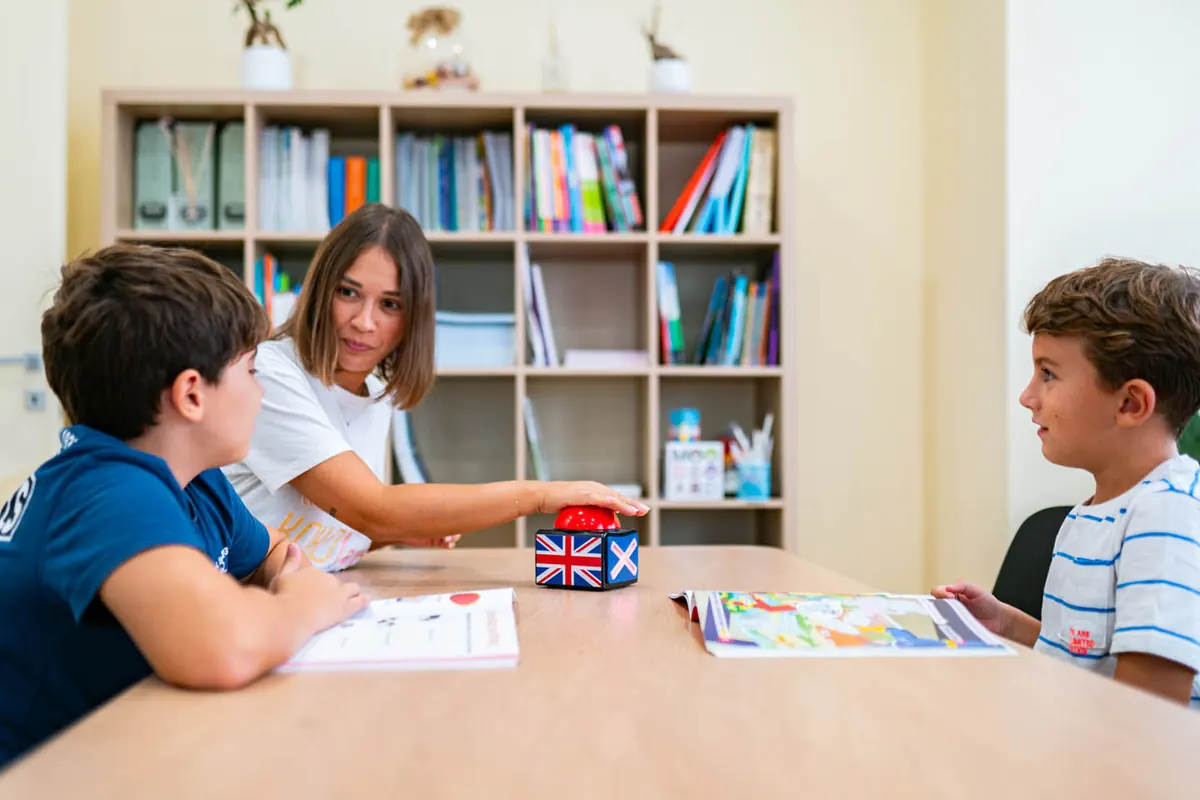
How to play: one plays the shopkeeper, the other the customer. You ask, count and say thank you. In class we play the same role-play game with the words of the week.
The phrases to use:
The trick: play the absent-minded shopkeeper who hands over the wrong fruit: the child will correct you in English.
7. Memory
Materials: the printable cards (the PDF has fruit, animals and household objects).
How to play: the cards lie face down on the table; in turn you flip two and say aloud the name of what you see. If they match, you keep them.
The phrases to use:
8. Hot and cold
Materials: a small object to hide.
How to play: hide the object; while the child searches, guide them with “warmer” if they get closer and “colder” if they move away. Then they hide it and guide you.
The phrases to use:
English games for children aged 9, 10, 11 and 12
Older children want games that make them think and speak in full sentences: ask them to explain the rules to you in English.
9. Twenty questions
Materials: none.
How to play: one person thinks of an animal or an object; the other has twenty yes-or-no questions to guess it.
The phrases to use:
10. Cooking in English
Materials: a simple recipe: pancakes, biscuits, a fruit salad.
How to play: you cook together, saying the ingredients and the actions in English.
The phrases to use:
11. Would you rather
Materials: none: perfect at the dinner table.
How to play: in turn you offer an impossible choice and the other answers, explaining why.
The phrases to use:
12. Story chain
Materials: optional: three objects picked at random around the house, to work into the story.
How to play: one person starts the story with a sentence, the next adds another, and so on. If a word is missing, say it in Italian and look for it together.
The phrases to use:
All the games in one table
| Game | Age | What it trains |
|---|---|---|
| Simon says | 3–5 | body parts, actions |
| Colour hunt | 3–5 | colours |
| Mystery bag | 3–5 | objects, yes/no questions |
| Animal walk | 3–5 | animals, commands |
| I spy | 6–8 | colours, objects, questions |
| The shop | 6–8 | food, numbers, politeness |
| Memory | 6–8 | vocabulary by topic |
| Hot and cold | 6–8 | listening, comparatives |
| Twenty questions | 9–12 | questions, descriptions |
| Cooking in English | 9–12 | instructions, food |
| Would you rather | 9–12 | opinions, “because” |
| Story chain | 9–12 | storytelling, linking words |
Do you need apps and screens to learn English through play?
To play English games at home, you don’t: all these games are screen-free. If you do use a screen, what counts is how the child uses it. Up to the age of 5, the Italian Society of Paediatrics recommends less than an hour a day, with quality programmes and an adult alongside, and no devices at all under 2. A useful screen asks the child to do something.
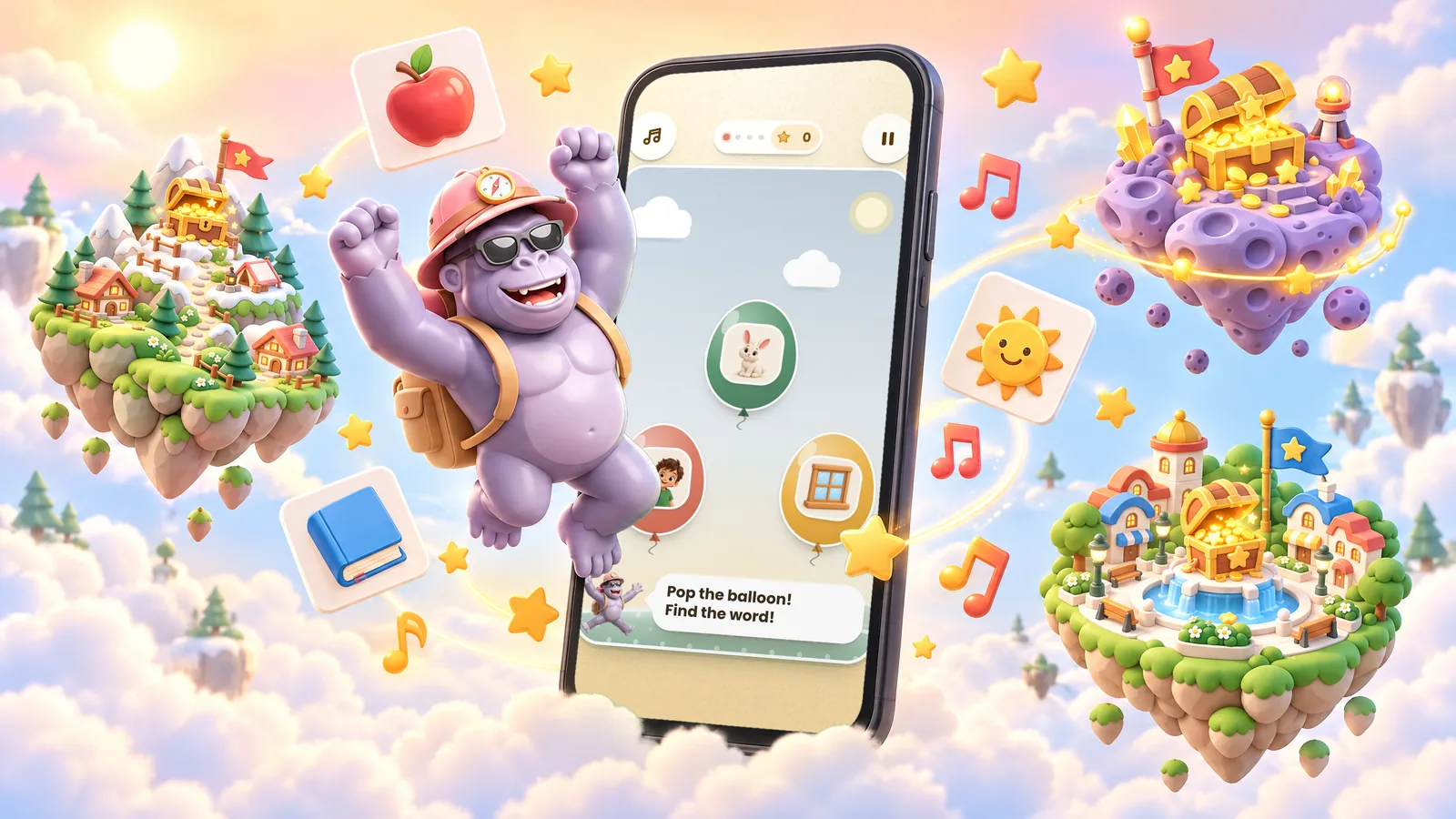
It’s the principle behind KOKO Play, KOKOland’s learning game: twenty minutes a day of games, songs and challenges in English, always matched to the right level, with the words being covered in class and voice games where the child answers Koko out loud. We tell the story in KOKO Play, the app for learning English that was born in a school. To choose cartoons well too, we’ve prepared a guide to cartoons in English for children, by age.
Mistakes to avoid
- Turning the game into a test. “How do you say dog?” kills the fun: use the word inside the game.
- Correcting every mistake. If a child says “I goed”, reply “Yes, you went!”: repeat the right form, with a smile, and move on.
- Pushing when they don’t want to speak. Understanding comes before speaking: if a child listens and joins in with gestures, they are already learning. We talk about it in the article on the silent period: when a child understands English but doesn’t speak it.
Frequently asked questions
Which English games can I play with children at home?
The most effective are simple and repeatable: Simon says and the mystery bag from 3 to 5, the shop and the “hot and cold” treasure hunt from 6 to 8, twenty questions and the story chain from 9 to 12. A few objects from around the house and 5 minutes a day are enough.
How can I help children with English if I’m not confident speaking it?
Be the playmate, not the teacher. Learn two or three phrases at a time by listening to the correct pronunciation, always use them in the same games, and let the child correct you.
How much time a day does it take to learn English through play at home?
5 minutes a day are enough, as long as it’s every day. Memory research shows that short, spaced-out practice works better than one long session now and then.
Which English games work for a 3-year-old?
Movement and object games, with one or two words at a time: Simon says (“touch your nose!”), the colour hunt, the mystery bag and the animal walk. At 3, children understand long before they speak: if they answer with a gesture, the game is working.
Do you need apps to learn English through play?
They aren’t essential; a good app helps if it makes the child work actively and adapts to their level. Up to the age of 5, the Italian Society of Paediatrics recommends staying under an hour of screen time a day, with an adult alongside.
We do the rest
At home, 5 minutes of play are enough; at our school there are two sessions a week of 60 minutes each, in groups of up to 6 children of the same age with native or bilingual teachers. In class the activities change about every 15 minutes, between songs, the interactive whiteboard, stories and team games. To see it first-hand there is the Demo Day, the free session inside a real KOKOland class with children of the same age, at our schools in Martina Franca and Monopoli. Send us a request and we’ll get back to you.
Sources
- Place, Hoff (2011), Properties of Dual Language Exposure that Influence Two-Year-Olds’ Bilingual Proficiency, Child Development
- Hirsh-Pasek, Zosh, Golinkoff, Gray (2015), Putting Education in “Educational” Apps: Lessons From the Science of Learning, Psychological Science in the Public Interest
- Cepeda, Pashler, Vul, Wixted, Rohrer (2006), Distributed practice in verbal recall tasks: A review and quantitative synthesis, Psychological Bulletin
- Asher (1969), The Total Physical Response Approach to Second Language Learning, The Modern Language Journal
- Bozzola and colleagues (2018), Media devices in pre-school children: the recommendations of the Italian pediatric society, Italian Journal of Pediatrics
Keep reading

Free Demo Day
Book a free Demo Day.
A real, free lesson in a KOKOland class of children the same age. You stay at the school and we explain the method.