
Cartoons in English for children: how to use them so they really work
10 October 202610 min read
In brief
- The best cartoons in English for children are slow, with short sentences and everyday situations: Peppa Pig at 2-3, Bluey at 4-5, StoryBots at 6-8, Phineas and Ferb at 9-12.
- Accent and level matter: British, Australian and American all work, as long as the pace is within a child’s reach.
- No subtitles up to the age of 5; after that, English subtitles on episodes already seen. Watching together is always better, and under an hour a day until the age of 5.
- On their own they are not enough: they train listening, but speaking is learned with people.
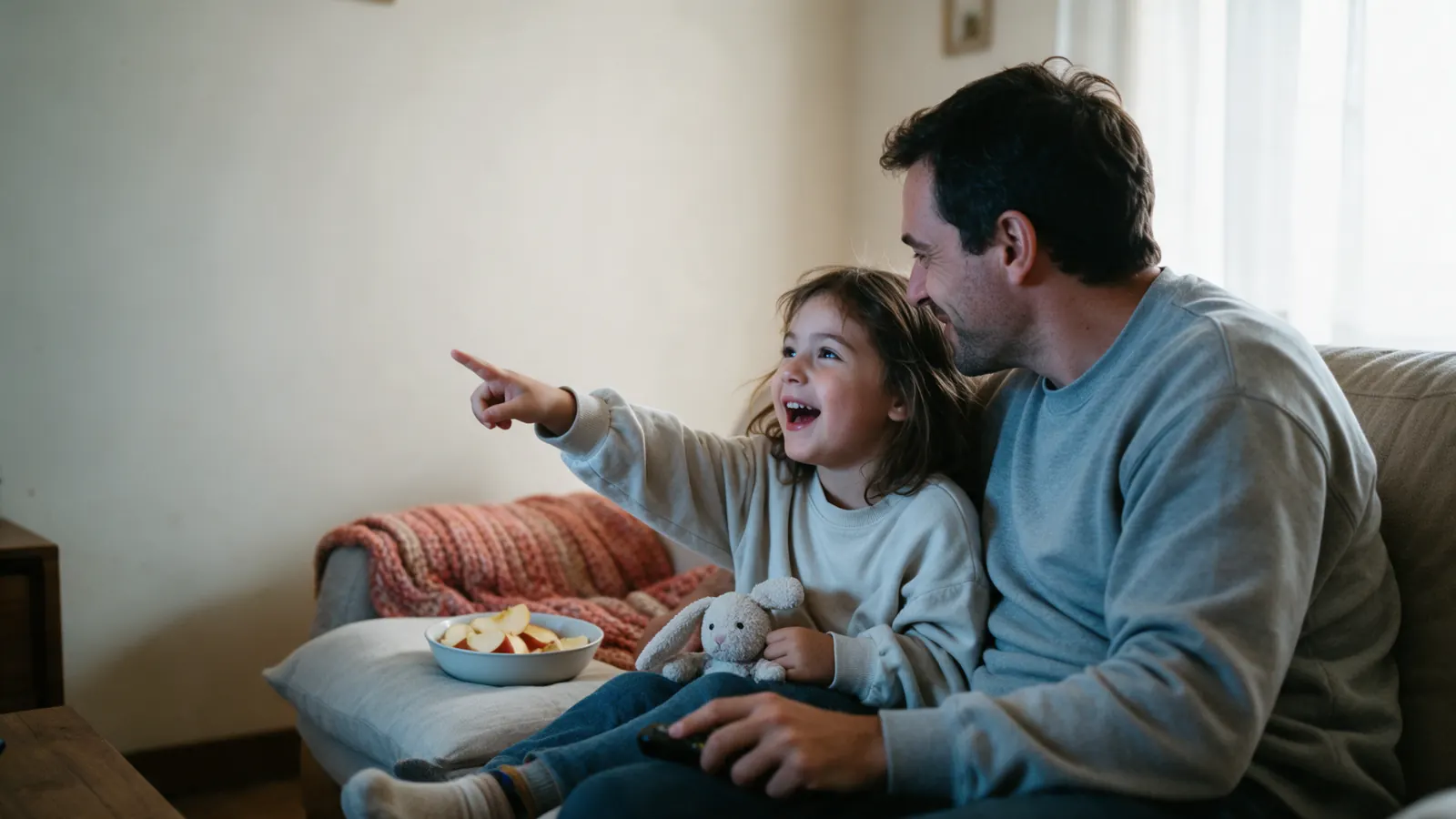
Putting a cartoon on in English does not teach English by itself. What makes the difference is how you watch it: together, with the same episode repeated more than once, with a few questions in English along the way and, when children can read, the right subtitles. The title matters too, because the best cartoons in English for children are the ones a child can follow even without knowing every word: slow stories, short sentences, pictures that explain what is said. Here you will find a selection by age, with where to watch each one in Italy, the accent, an approximate level and the rules we suggest to families.
Which cartoons in English should you choose, age by age?
In the table we have put a few series, chosen with care: a pace that suits the age, clear language, short episodes and real availability in Italy with an English audio track. The level is our own approximate estimate on the European scale for languages (Pre-A1, A1, A2, B1): a child’s level counts for more than their age.
| Age | Cartoon | Where to watch it in Italy | Accent | Approximate level | What it trains |
|---|---|---|---|---|---|
| 2-3 years | Peppa Pig | Disney+ and Prime Video (English audio indicated), official YouTube channel | British | Pre-A1 | family phrases, greetings, colours, emotions |
| 2-3 years | Hey Duggee (shown in Italy as “Oi, Duggee!”) | Netflix and Timvision (check the language on the platform), official YouTube channel | British | Pre-A1 | a calm narrator, few words, lots of repetition |
| 2-3 years | Super Simple Songs | official YouTube channel | North American | Pre-A1 | slow songs with actions: body, numbers, routines |
| 4-5 years | Bluey | Disney+ (English audio indicated), RaiPlay (check the language) | Australian | Pre-A1 / A1 | pretend play, family dialogue, emotions |
| 4-5 years | Numberblocks | Hopster on Prime Video (English audio), official YouTube channel | British | Pre-A1 | numbers and quantities, very simple sentences |
| 4-5 years | Puffin Rock | Netflix (check the language on the platform) | Irish (narrator) | Pre-A1 | nature and animals, calm pace |
| 6-8 years | Ask the StoryBots | Netflix | American | A1 | “why?” questions, songs, real-world vocabulary |
| 6-8 years | Octonauts | official YouTube channel (not currently streaming in Italy) | British | A1 | sea animals, action verbs, teamwork |
| 6-8 years | PAW Patrol | Paramount+ (English audio indicated), Netflix | North American | A1 | actions and jobs; fast pace, best in small doses |
| 9-12 years | Phineas and Ferb | Disney+ (English audio indicated) | American | A2 | wordplay, songs, everyday English |
| 9-12 years | Gravity Falls | Disney+ (English audio indicated) | American | A2 / B1 | mystery and humour; from age 10, a few scenes are scary |
| 9-12 years | The Amazing World of Gumball | HBO Max (English audio indicated), Netflix | American | A2 / B1 | quick jokes, colloquial English |
Availability checked on Italian catalogues in mid-October 2026. Catalogues change often and not every platform offers the English track for every season: before you subscribe, always check the audio language on the platform.
Which cartoons are worth watching to learn English?
Before the title, look at a few features. A cartoon that is useful for English has short, repeated sentences, a slow pace, everyday situations (breakfast, the park, bedtime) and pictures that explain the words: if a child sees the puddle while hearing “muddy puddle”, they understand without a translation. Shorter episodes, from 5 to 10 minutes, are better because they can be watched again. In its 2018 recommendations, the Italian Society of Paediatrics also advises against fast-paced programmes or ones with violent content: for English too, calm helps.
2-3 years: few words, lots of repetition
At this age, stories with almost no plot work best, with a narrator who describes what you see. Peppa Pig is the classic starting point: the accent is British, the sentences are very short and the situations are the same as those in a child’s own life. Slow songs with actions, like those from Super Simple Songs, get the body moving along with the words.
4-5 years: stories, emotions and numbers
A taste for real stories arrives. Bluey is loved by parents too: the Australian accent is different from the one in school books, but that is not a problem, because children’s ears get used to several accents quickly. Numberblocks combines English and numbers; Puffin Rock is perfect in the evening, with its quiet pace.
6-8 years: curiosity and real-world vocabulary
Children ask a thousand questions, and Ask the StoryBots answers by singing: why the sky is blue, how a tooth works. Octonauts brings precise words about animals and the sea. PAW Patrol is very popular, but it is fast: fine as a treat, less so as the main tool.
9-12 years: humour and real English
Here English becomes the English people actually speak, with jokes and idioms. Phineas and Ferb has catchy songs and one funny detail: Ferb, the English brother, hardly speaks at all. Gravity Falls and Gumball are ideal with English subtitles, so the jokes are not lost.
Is it better with Italian subtitles, English subtitles or none?
It depends above all on one thing: whether a child can already read, and in which language. Here is the strategy we suggest.
| Age | Audio | Subtitles | Why |
|---|---|---|---|
| 2-5 years | English | none | they can’t read yet: they look at the pictures and listen, while you comment |
| 6-8 years | English | English on episodes already seen; Italian only the first time through a difficult episode | reading and hearing the same sentence helps to recognise the words |
| 9-12 years | English | English as the rule, then none as well | English subtitles help to follow fast dialogue and jokes |
Research supports this choice. A meta-analysis published in System (Montero Perez and colleagues, 2013) brought together studies on videos with subtitles in the same language as the audio: they help both listening comprehension and word learning. In Belgium, a study of 374 children in their last year of primary school (Kuppens, Learning, Media and Technology, 2010) found that those who often watched programmes and films in English with subtitles got better results in translation tests. It is an association, not proof of cause and effect, but it points in the same direction.
How to watch cartoons in English together, even if you don’t speak English
A cartoon watched alone is passive listening; the same cartoon watched together becomes a conversation. You don’t need to speak English well: a few questions are enough, and you can listen to them here with the correct pronunciation.
- Choose an episode and watch it again. By the third time a child anticipates the lines: it is the sign that the words are staying. Finish with
- Pause and ask. Point at a character and ask or . If the answer comes in Italian, that is perfectly fine: you say the word in English.
- Play with what you see. and work with any cartoon.
- Make them guess. Before a key scene:
- Take the cartoon off the screen. If Peppa jumps in puddles, the next time it rains, jumping together and saying “muddy puddles” will be the best revision of all.
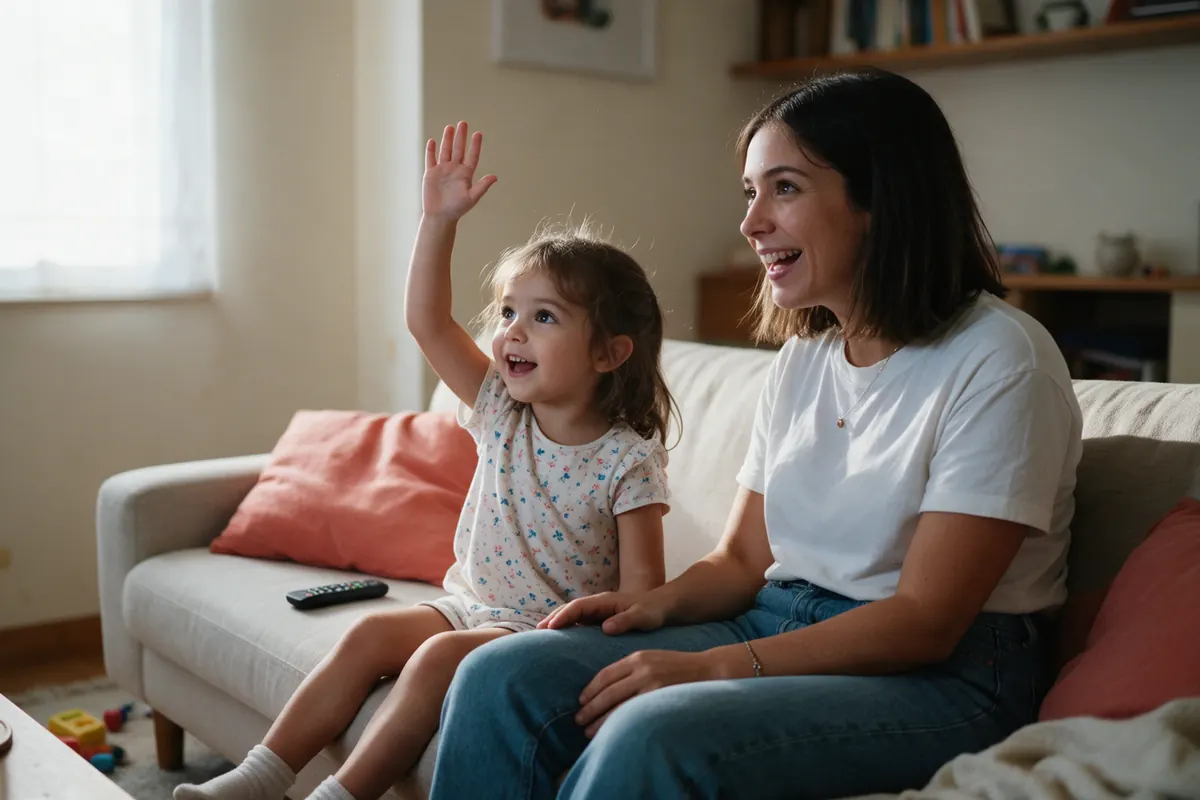
Download the “Let’s watch together” worksheet (PDF): 5 questions in English to keep next to the sofa
How much screen time is reasonable?
Even when they are in English, cartoons are still time in front of a screen. These are the reference points from the main scientific societies.
| Age | Guidance | Source |
|---|---|---|
| Under 2 | no devices | Italian Society of Paediatrics, 2018 |
| 2-5 years | less than 1 hour a day, quality programmes, with an adult | Italian Society of Paediatrics, 2018; WHO, 2019 (ages 2-4: no more than 1 hour, less is better) |
| 5-8 years | less than 2 hours a day | Italian Society of Paediatrics, 2018 |
| All ages | no screens during meals and at least in the hour before bed | Italian Society of Paediatrics, 2018 |
| Up to 13 years | put off a personal smartphone until at least 13 | Italian Society of Paediatrics, 2025 update |
For older children the American Academy of Pediatrics suggests a family media plan, built together, with clear rules and screen-free moments, instead of one number that suits everyone. In practice: two short episodes in English, watched together and then talked about at dinner, are better than an afternoon of autoplay.
Are cartoons in English enough to learn the language?
No, and it is better to say so honestly. Cartoons train the ear, bring new words and make English feel like a living, fun language. But to speak you need people. In a study by Patricia Kuhl and colleagues (PNAS, 2003), 9-month-old babies learned to recognise the sounds of Mandarin Chinese from real people, while the same people on video produced no learning at all. And in the study by Place and Hoff (Child Development, 2011), English skills grew with the number of different people the children heard it from. It is one of the seven myths we take apart in our article on the myths of early bilingualism.
That is why, at KOKOland, a screen, when there is one, always asks children to do something. In class they play on the interactive whiteboard by touching, dragging and answering, in groups of at most 6 children of the same age; at home there is KOKO Play, the learning game that picks up the words from class and in which you answer Koko out loud. We tell the story of how we designed it in KOKO Play, the English learning app born in a school. If you would like some screen-free ideas, we have also collected twelve English games to play at home.
Frequently asked questions
Which cartoons should children watch to learn English?
The slow ones, with short sentences and everyday situations where the pictures explain the words: Peppa Pig and Hey Duggee at 2-3, Bluey and Numberblocks at 4-5, StoryBots and Octonauts at 6-8, Phineas and Ferb and Gravity Falls at 9-12. How you watch matters more than which title you pick: together, and with the same episodes repeated.
Where can you watch cartoons in English in Italy?
On the platforms that offer the original audio track (Disney+, Netflix, Prime Video, Paramount+, HBO Max and, for some titles, RaiPlay) and on the series’ official YouTube channels. You choose English from the audio and subtitles menu in the player; catalogues change often, so it is worth checking on the platform.
Is it better to use Italian subtitles, English subtitles or none?
No subtitles up to the age of 5: children can’t read yet. From 6-8, English subtitles on episodes they have already seen, and Italian ones only to follow the plot of a new episode. From 9, English subtitles become the rule.
At what age can children start watching cartoons in English?
The Italian Society of Paediatrics advises against screens before the age of 2. From 2 you can start with slow, short cartoons watched together with an adult, staying under an hour a day until the age of 5.
Is Peppa Pig in English a good choice?
Yes, it is one of the best places to start: episodes of about 5 minutes, very short sentences, family situations and a narrator who describes what you see, with a British accent. It works between 2 and 5; later it becomes too easy.
Are cartoons in English enough to learn the language?
No. They train listening and bring new words, but to speak you need people to use the language with. Cartoons are a great complement to a pathway with native-speaking or bilingual teachers, not a substitute.
Come and see how we do it
If you want to understand how English moves from the screen to people, the best way is to see it. At Demo Day, the free session inside a real KOKOland class with children of the same age, the children play in English and you can ask us anything you like. For the youngest, start with KOKO Stars, ages 3 to 6. Send us a request: we will reply ourselves.
Sources
- Bozzola and colleagues (2018), Media devices in pre-school children: the recommendations of the Italian pediatric society, Italian Journal of Pediatrics
- World Health Organization (2019), Guidelines on physical activity, sedentary behaviour and sleep for children under 5 years of age
- Dire (2025), No mobile phones before 13: paediatricians update their digital guidance (article in Italian)
- American Academy of Pediatrics, Family Media Plan
- Montero Perez, Van Den Noortgate, Desmet (2013), Captioned video for L2 listening and vocabulary learning: A meta-analysis, System
- Kuppens (2010), Incidental foreign language acquisition from media exposure, Learning, Media and Technology
- Kuhl, Tsao, Liu (2003), Foreign-language experience in infancy, PNAS
- Place, Hoff (2011), Properties of Dual Language Exposure that Influence Two-Year-Olds’ Bilingual Proficiency, Child Development
Keep reading
Free Demo Day
Book a free Demo Day.
A real, free lesson in a KOKOland class of children the same age. You stay at the school and we explain the method.