
How to tell what level of English a child is at: signs, age and tests
9 October 202610 min read

In brief
- English level is described with the Common European Framework (CEFR): Pre-A1, A1, A2, B1, B2, C1, C2. Each level says what a child can do with the language, not how many words they know.
- To get your bearings: Italian schools aim for A1 at the end of primary school and A2 at the end of middle school. More hours of real English, with real people, bring these goals forward.
- A school grade is not a level: it measures the goals of the class. For a true level you need a certificate, such as the Cambridge exams for children, or a test built on the CEFR.
- KOKOland’s online English test is an adaptive game for ages 4 to 18: it awards a level only when it is proven, with at least 70% correct answers on the questions of that level.
“So what level are they at?” It is the question parents ask themselves in front of a school report, before choosing a course, before a Cambridge exam, or when a child suddenly sings a whole song in English. The answer is not in a grade, nor in the number of words they know: it is in what they manage to do with the language. Here is how to find out, with simple tools and a few signs to look for at home.
What does “English level” mean? The CEFR explained to parents
The Common European Framework of Reference for Languages, CEFR for short (QCER in Italian), is the Council of Europe scale used by schools, certification bodies and universities across Europe. It has six levels, from A1 to C2, grouped into three bands: A, basic user; B, independent user; C, proficient user. The 2020 Companion Volume also describes an earlier step, Pre-A1, which covers the very first steps and is especially useful with young children.

What makes the CEFR special is that it describes levels with “can do” statements: can introduce themselves, can understand a short message, can tell what they did. It is the most honest way to look at a child’s English, because it puts the use of the language at the centre.
| Level | In a few words | Matching Cambridge exam | School goal in Italy |
|---|---|---|---|
| Pre-A1 | recognises simple words and instructions | Pre A1 Starters | first years of primary school |
| A1 | simple sentences about themselves and their world | A1 Movers | end of primary school |
| A2 | copes in everyday situations | A2 Flyers, A2 Key for Schools | end of middle school |
| B1 | independent when travelling, can tell and explain | B1 Preliminary for Schools | end of the first two years of upper secondary school (licei) |
| B2 | talks fluently, can argue a point | B2 First for Schools | end of upper secondary school |
| C1 | uses the language effectively for study | C1 Advanced | beyond school |
What level of English should a child have at their age?
There is no single “right” level for each age that works for everyone: it depends on how many years of English a child has behind them, how many hours a week, and how much they really use it. There are, however, useful reference points. Italian schools set A1 at the end of the last year of primary school (in Italy, ages 6–11) and A2 at the end of the final year of middle school (age 13); in the licei, the academic upper secondary schools, the goal is B1 at the end of the first two years and B2 at the end of the course. Cambridge offers Starters, Movers and Flyers as exams for the youngest, the young learners: more than age, what counts is being ready.
Read these goals as a starting point, not a ceiling. A child who has followed a programme with more hours of English and native-speaker teachers since the age of 3 can reach each step sooner; a teenager who started late can catch up quickly. What matters is that the level grows year after year, solid, with no gaps in listening and speaking. For school hours and the level expected in primary school, year by year, see our guide to English in primary school.
How to tell a child’s English level at home: the signs at every step
Without tests and without quizzing, simply watching a child in everyday life already tells you a lot. Here are the typical signs for the first four steps, the same ones we use to describe the results of our test.
Pre-A1: the first words
- They recognise everyday words: colours, numbers, animals, objects around the house.
- They understand short, simple instructions, especially with gestures and pictures.
- They answer easy questions about themselves, such as their name and age.
A1: the first sentences
- They understand and use simple sentences about themselves, their family, school and what they like.
- They read short texts with familiar words, such as notes, signs and comics.
- They ask and answer simple questions, if the other person speaks slowly and clearly.
A2: getting by
- They understand sentences on everyday topics: family, school, shopping, free time.
- They say in a simple way what they did and what they will do.
- They read messages, short emails and notices and pick out the main information.
B1: independent
- They understand the main points when people talk about school, hobbies and travel.
- They cope in almost every situation while travelling and can give their opinion in a simple way.
- They write simple, connected texts on topics they know, such as an email to a friend.
One practical tip: look at listening first. A child who follows a cartoon in English without subtitles, or picks up a new song on the second listen, is building the base that every other level rests on. And remember that children almost always understand more than they can say: at every age, speaking arrives after understanding.
Download the checklist of signs to tick off, from Pre-A1 to B1 (PDF, in Italian)
Why doesn’t an English grade tell you the level?
In primary school, since the second term of 2024/2025, assessment has gone back to descriptive judgements: ottimo (excellent), distinto (very good), buono (good), discreto (fair), sufficiente (sufficient), non sufficiente (insufficient). They are valuable, but they answer a different question: how well a child has met the goals of their class. An “ottimo” in the third year of primary school says the third-year programme has been mastered, not that the child is A2.
Even the INVALSI test, the Italian national school tests, which is built on the CEFR, looks at only part of the picture: in the last year of primary school and in the final year of middle school it measures reading and listening, not speaking and not writing. And then there is the difference of context: at school the work is on what has just been studied, while a true level shows when the language is needed in a new situation. That is why you can meet a child with excellent grades who freezes at an unexpected question, and another with average grades who chats to everyone on holiday.
Are Cambridge exams a good measure of level?
Yes, for many children they are the most complete way to measure it, because they assess all four skills: listening, reading, writing and speaking. The exams for children, Pre A1 Starters, A1 Movers and A2 Flyers, have no pass or fail: every child receives a certificate with a score in shields for each paper, up to five. After Flyers the path continues with the “for Schools” exams: A2 Key, B1 Preliminary, B2 First.
They have two limits worth knowing: they are held on fixed dates, and it makes sense to enter when a child is ready for that level, not to “find out” where they are. We have explained format, length and results in our guide to Cambridge exams for children: Starters, Movers and Flyers. At KOKOland the exams are taken on site from age 7, always optional: the family chooses if and when, and the page on Cambridge exams explains how we prepare for them.
Is there a reliable online English test for children?
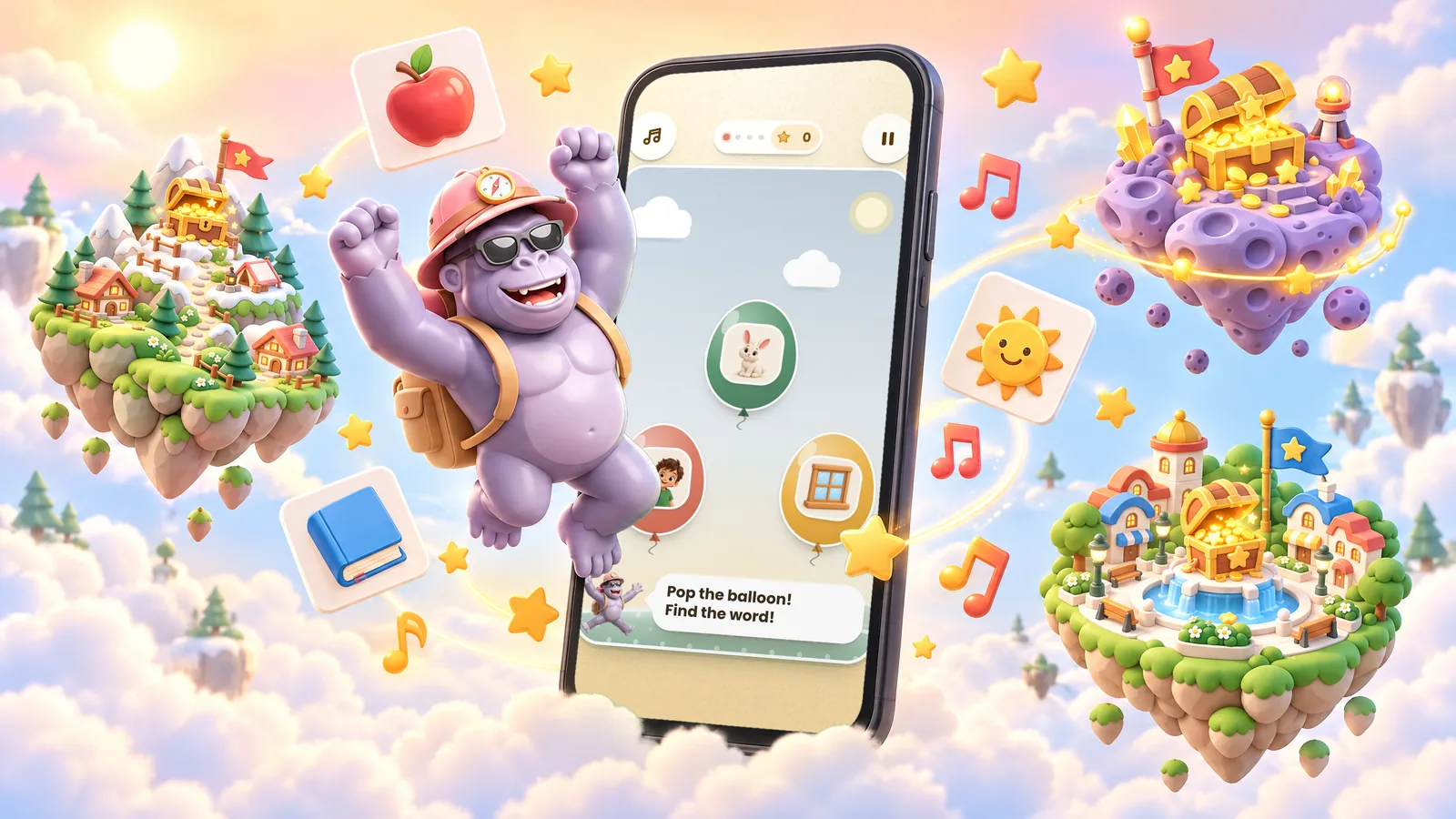
To get your bearings before an exam or a course you need something quicker. That is why we built KOKOland’s online English test, free and in the form of a game with Koko, our gorilla. Here is how it works, no secrets.
- It adapts to the player. You choose the age, from 4 to 18, and every answer steers the next question: if a question is easy the challenge goes up, if it is hard it comes down. This way the test measures close to the real level without boring or discouraging anyone.
- It changes with age. From 4 to 6 you play together with an adult, with pictures and audio, no reading needed; from 7 to 10 it is a mission across the islands; from 11 to 13 a challenge in levels; from 14 to 18 a real level check. It runs from about ten questions for the youngest to about thirty for teenagers.
- Four skills. Listening, vocabulary, grammar and reading, in rotation.
- A level is awarded only when it is proven. This is the rule we care about most: a level appears in the result only if the child answers at least 70% of the questions of that level correctly, with enough questions asked and the step below solid. It is the same spirit as the Cambridge certificates. In in-between cases the test shows the lower level and the step coming up: “A2 · towards B1”.
- A result you can read. The estimated CEFR level, the matching Cambridge exam, a percentage for each skill and the “can do” sentences for that level. The result is emailed to the parent, and whoever plays takes home a collectable card.

With the same honesty, here is what the test does not do: it does not measure speaking and writing, and it remains an estimate. That is why, at the Demo Day, the level is confirmed by the teacher, on site, watching the child inside a real class with peers.
When it makes sense to measure the level (and when it doesn’t)
- It makes sense before choosing a course or a group, before entering a Cambridge exam, and at the start of a new year to see how far they have come.
- It does not make sense to do it every month: the level grows in slow steps, and a test repeated too often measures the mood of the day more than the English.
- Don’t turn it into a grade. With children the result should be told as an achievement (“you’ve reached A1, now we aim for A2”), never as a judgement.
Guess the level: the quiz for parents
Six situations, six questions: can you spot the right step?
Frequently asked questions
How do I find out a child’s level of English?
Watch what they can do with the language: understand instructions, introduce themselves, tell a story, read a message. Then compare it with the CEFR levels. For a more precise result you can use a test built on the CEFR, like KOKOland’s free one, or a Cambridge certificate.
What level of English does a 10-year-old have?
It depends on the years and hours of English behind them. The Italian school benchmark is A1 at the end of the last year of primary school, around age 10–11; with more exposure to English, many children reach A2 in those same years.
Is A1 a good level for a child?
Yes: A1 is the goal that schools set at the end of primary school. It means using simple sentences about themselves and their world and understanding people who speak slowly: a solid base to build A2 on.
Is KOKOland’s online English test free?
Yes. It is an adaptive game with Koko, for ages 4 to 18, covering listening, vocabulary, grammar and reading. The result, with the estimated CEFR level and the matching Cambridge exam, is emailed to the parent.
What does “A2 · towards B1” mean in the test result?
That the A2 level has been proven and that part of B1 has already been reached. The test awards a level only with at least 70% correct answers on the questions of that level: in in-between cases it always shows the lower level.
Does a school grade match a CEFR level?
No. A school judgement measures how well the goals of the class have been met; the CEFR level describes what someone can do with the language, in any context.
From level to learning path
Knowing the level serves one purpose: choosing the next step. Start with Koko’s test, which you can do from home in a few minutes. Then, if you like, book the free Demo Day: a session inside a real KOKOland class, with children of the same age, where the teacher sees the child at work and advises you on the right path. At home, enrolled families carry on with KOKO Play, where an algorithm follows every answer and keeps the level just right. Send us a request: we look forward to seeing you in Martina Franca or Monopoli.
Sources
- Council of Europe, CEFR: global scale of common reference levels
- Council of Europe, CEFR Companion Volume (2020)
- Cambridge English, Young learners: Pre A1 Starters, A1 Movers, A2 Flyers
- INVALSI, reading guide to the English test, grade 5, school year 2025/2026 (in Italian)
- Eurydice, Italy: assessment in primary education
- Italian national guidelines for the licei, foreign language and culture (text hosted by a school, in Italian)
Keep reading


Free Demo Day
Book a free Demo Day.
A real, free lesson in a KOKOland class of children the same age. You stay at the school and we explain the method.