
Telling the time in English for children: 5 steps with the talking clock
7 October 202610 min read

In brief
- To tell the time in English, say It’s + the time: (the exact hour), (thirty minutes after three), (fifteen minutes before four).
- The golden rule: up to the half hour you count after the hour with past; after the half hour you count towards the next hour with to.
- Children learn it in five steps: exact hours, half hours, quarters, minutes, a.m. and p.m. In England, children work on this between the ages of 5 and 8.
- Below you will find an interactive clock that says every time out loud, tables with audio, a quiz and a paper clock to print and cut out.
“What time is it?” is one of the first real questions a child learns to ask in English, and one of the first where Italian can trip them up. In Italian the hour comes first and the minutes follow; in English the minutes come first and the hour comes last, as in “ten past three” or “quarter to four”. That is why time needs to be taught one step at a time, always with a clock in front of the child’s eyes: start with what is easy, add one idea at a time and, at the end, play.
How do you ask the time in English?
The most common question is . In Britain you also hear , while with a stranger in the street you start politely: . The answer always begins with It’s, in the singular: in English the time “is”, it never “are”.
Watch out for the first trap: Italian-speaking children often turn the question word for word into what hour. Hour means a length of time (“an hour’s journey”), while for the time of day you use time.
How do you tell the time in English? The 5-step method
Each step adds just one idea: stay on it until it becomes automatic, then move on to the next.
Step 1. Exact hours: o’clock
When the long hand points to 12, say the number of the hour followed by o’clock: , , . O’clock is a contraction of of the clock and is used only with exact hours. It is the perfect step for the youngest children too: all they need is the numbers from 1 to 12.
Step 2. The half hour: half past
When the long hand points to 6, half an hour has gone by: , literally “half after three”. A trick that works: colour the right-hand half of the clock face yellow, from 12 to 6, and explain that this is the past half, where the hour has “just gone by”.
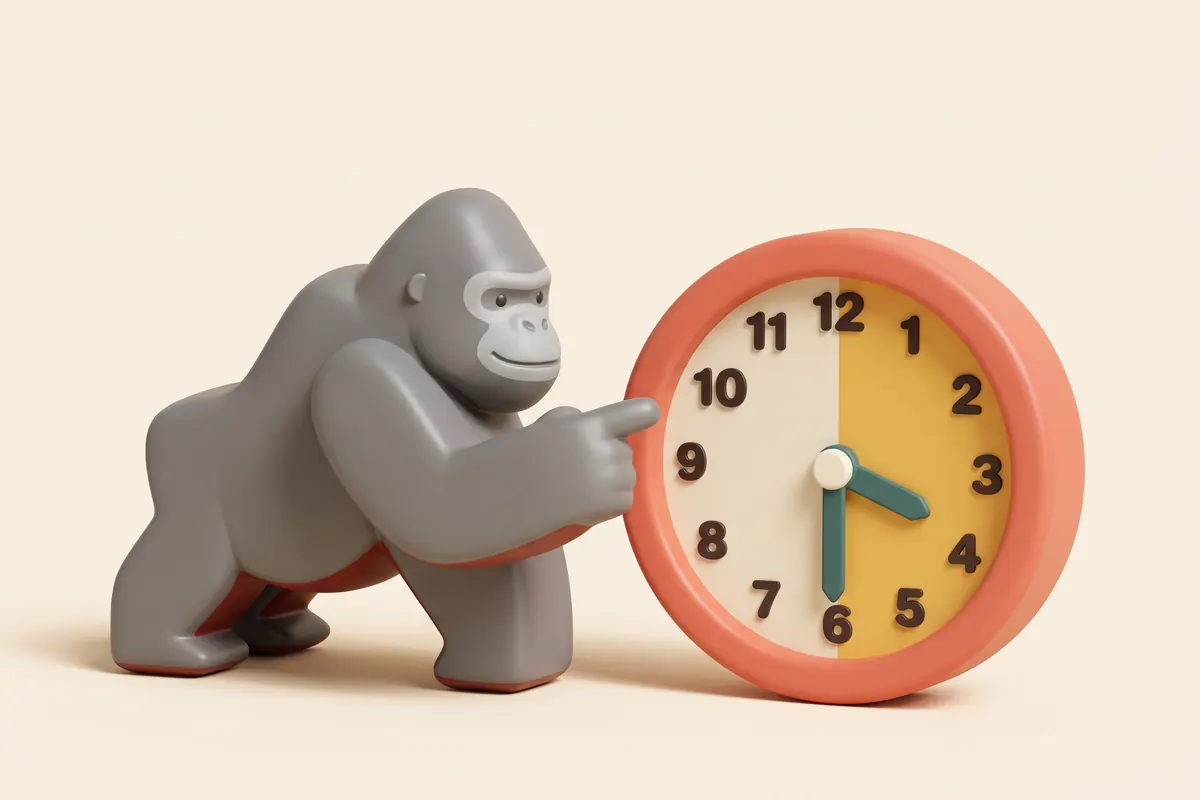
Step 3. Quarters: quarter past and quarter to
Here comes the golden rule. On the right-hand side of the clock face you count after the hour: with the long hand on the 3, you say . On the left-hand side you count how long it is until the next hour: with the long hand on the 9, you say . A quarter of an hour is left before four, so the next hour is the one you name. You also hear a quarter past, with the article: both are correct.
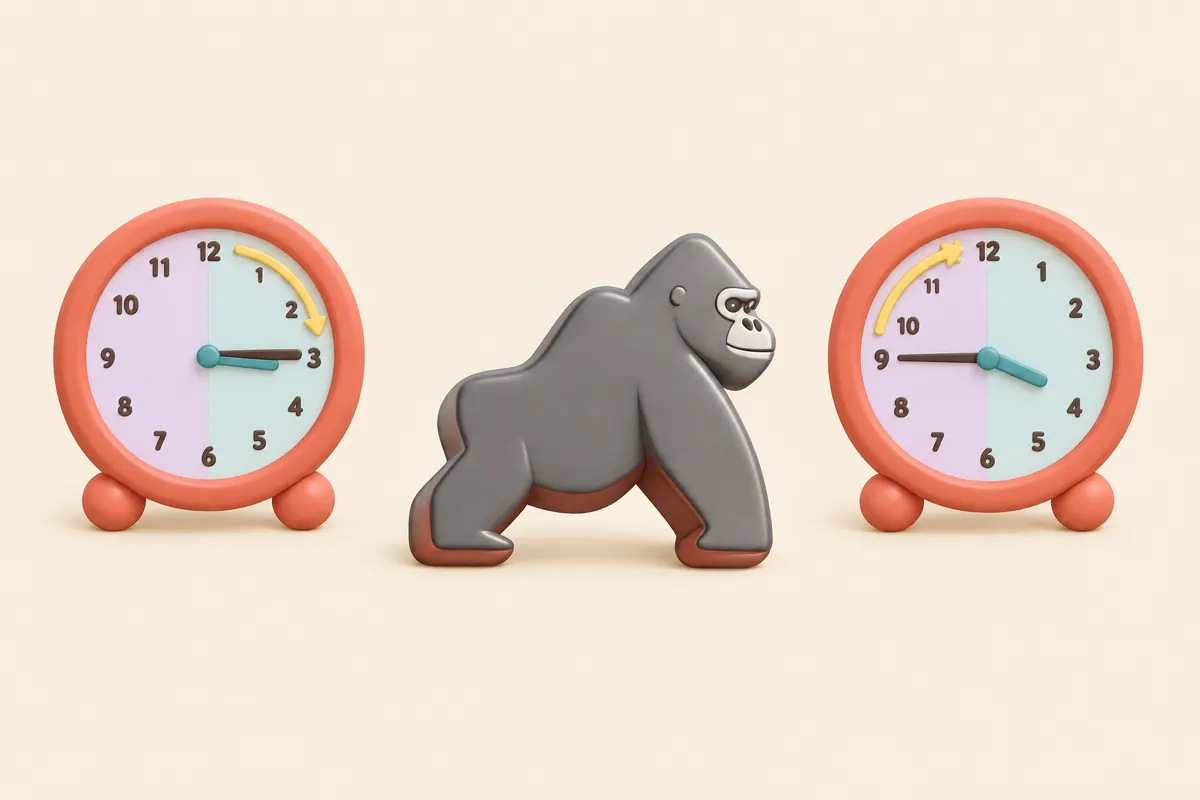
Step 4. Minutes: five past, twenty to and the rest
Now just apply the same rule to every number on the clock face, counting in groups of five minutes. Here are all the positions, using three o’clock as the example. Press each phrase to hear it.
| Time | In English | How to think about it |
|---|---|---|
| 3:00 | exact hour | |
| 3:05 | 5 minutes after three | |
| 3:10 | 10 minutes after | |
| 3:15 | a quarter after | |
| 3:20 | 20 minutes after | |
| 3:25 | 25 minutes after | |
| 3:30 | half an hour after | |
| 3:35 | 25 minutes to go until four | |
| 3:40 | 20 minutes to go | |
| 3:45 | a quarter to go | |
| 3:50 | 10 minutes to go | |
| 3:55 | 5 minutes to go |
Two details worth knowing. With multiples of five the word minutes is left out; with any other number of minutes it is added: , . And after the half hour you never say thirty-five past: you switch to the side of to.
Your turn: the talking clock
Move the hands five minutes at a time and listen to how the time is said. It works well as a game for two: you say a sentence in English, the child moves the hands; then you swap roles.
Step 5. Morning or evening: a.m. and p.m.
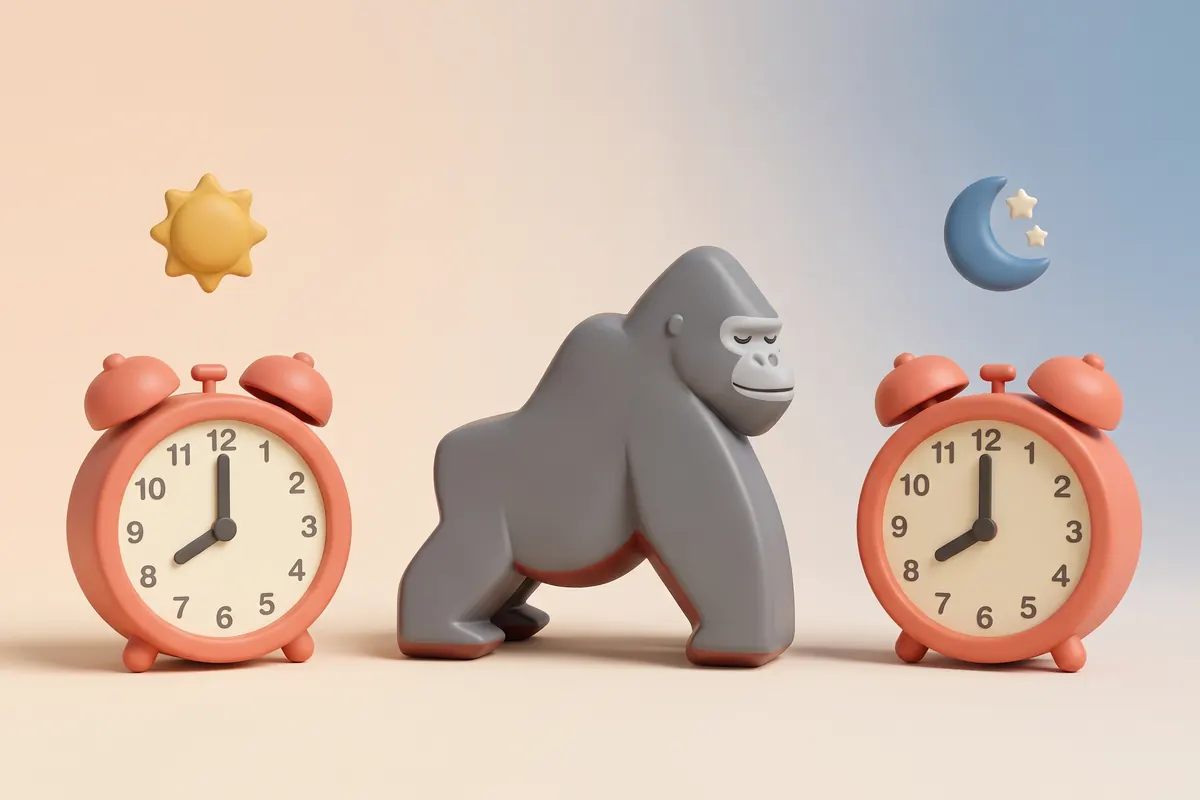
Everyday English almost always uses the 12-hour clock. To tell morning from afternoon there are two ways. In speech you add a short phrase: , , . In writing you use a.m. and p.m., from the Latin ante meridiem and post meridiem, “before” and “after midday”: a.m. runs from midnight to midday, p.m. from midday to midnight. So 8 in the morning is and 20:00 is . With a.m. and p.m. you don’t use o’clock: you say eight p.m., not eight o’clock p.m.
How do you say 9:30 in English? And 7:45, or 12:30?
Every time has two correct versions: the “analogue clock” one, typical of British speech, and the “digital” one, which reads the numbers just as they appear on the display.
| Time | Classic form | Digital form |
|---|---|---|
| 9:30 | ||
| 7:45 | ||
| 12:30 | ||
| 8:15 | ||
| 6:50 | ||
| 10:05 |
In the digital form a zero in the minutes is read as oh, like the letter: 10:05 becomes ten oh five.
What is the difference between “ten past two” and “two ten”?
None in meaning: both are 2:10. Ten past two comes from the analogue clock and is the form British children learn first at school; two ten reads the digital clock and is very handy for awkward times like 2:37 (two thirty-seven). Start with the classic form, which trains children to read the clock face; the digital one then arrives almost by itself.
Two curiosities that come in handy when travelling. In informal British speech you hear , which means half past three, not 2:30 as the words might suggest to a learner. In the United States, on the other hand, you may hear quarter after three instead of quarter past, and ten of four instead of ten to four.
How do you say 13:00 in English? The 24-hour clock, midday and midnight
In speech, 13:00 becomes or one p.m.: the 24-hour clock, which we use everywhere in Italy, appears in the UK mainly in timetables for trains, planes and programmes. When it is read aloud you say thirteen hundred for 13:00 and fifteen thirty for 15:30.
Midday is or , and midnight is . Even adults get confused by the labels 12 a.m. and 12 p.m.: to be clear, it is better to say twelve noon and twelve midnight, and that is what is worth teaching.
The most common mistakes of Italian-speaking children
Almost all of them come from translating word for word: correct them with a smile, by repeating the right sentence rather than explaining the rule.
| What you hear | What to say | Why |
|---|---|---|
| What hour is it? | What time is it? | for the time of day you use time |
| Are three o’clock. | It’s three o’clock. | in English the time is singular: it’s |
| It’s three and half. | It’s half past three. | the half hour comes before the hour, with past |
| It’s four less a quarter. | It’s quarter to four. | “less a quarter” is said with to |
| It’s three o’clock and ten. | It’s ten past three. | o’clock only with exact hours |
| It’s thirty-five past three. | It’s twenty-five to four. | after the half hour you switch to to |
| It’s fifteen o’clock. | It’s three o’clock / 3 p.m. | in speech you use the 12-hour clock |
At what age do children learn to tell the time in English?
A good reference point is the English national curriculum for mathematics, which shows what native-speaking peers learn (for English inside the Italian school system there is our guide to English in primary school, year by year). There the progression is gradual: in Year 1, at ages 5–6, exact hours and half hours; in Year 2, at ages 6–7, quarters and five-minute intervals; in Year 3, at ages 7–8, the exact minute, a.m. and p.m., midday, midnight and the 24-hour clock; in Year 4, at ages 8–9, converting between analogue and digital clocks.
For a child growing up in Italy, one other condition matters most: being able to read the clock in Italian already. If the clock face is secure, English comes quickly. Before then you can play with exact hours inside the daily routine at home: , .
How to teach the time in English at home: 5 five-minute games
- What’s the time, Mr Wolf? The classic British playground game. The wolf stands with their back to the others, who ask in chorus and the wolf answers, for example, “It’s three o’clock!”: everyone takes three steps forward. When the wolf shouts they spin round and try to catch the others.
- The paper clock. Print and cut out the clock with movable hands below: you say a time, the child makes it; then you swap roles. It works with the hands of a real wall clock too.
- The hours of the day. Read the clock at home together at fixed moments: breakfast, leaving the house, snack time, bath time. One sentence a day, the same one for a week, is worth more than a whole worksheet.
- Analogue and digital memory. On half of the cards draw a clock face, on the other half write the digital time: to take a pair, you have to say the time in English.
- The timer challenge. “You’ve got five minutes!”: a kitchen timer turns tidying up the bedroom into a race against the clock, in English.
Download the paper clock to print and cut out (PDF)
The secret is frequency: a few minutes, almost every day. It is the same principle behind KOKO Play, the learning game that KOKOland families use at home for about 20 minutes a day, always matched to the child’s level.
The clock quiz
Six questions to check whether the rule of past and to has become automatic: you read the question aloud, the child answers.
Frequently asked questions
How do you say “che ore sono?” in English?
You say What time is it? or What’s the time?. To ask a stranger: Excuse me, have you got the time?. The answer always begins with It’s, for example It’s half past four.
Do you say “quarter past” or “a quarter past”?
Both are correct: It’s quarter past three and It’s a quarter past three mean the same thing, fifteen minutes after three. In everyday British English you hear both.
How do you say 12:30 in English?
It’s half past twelve or, in the digital form, twelve thirty. If you need to be specific: half past twelve in the afternoon, that is 12:30 during the day.
Is midday 12 a.m. or 12 p.m.?
In common use midday is 12 p.m. and midnight is 12 a.m., but the labels often cause confusion. To be clear, say midday or twelve noon for midday, and midnight or twelve midnight for midnight.
When do you use o’clock?
Only with exact hours, when the long hand is on the 12: It’s five o’clock. You don’t use it with minutes (you never say five o’clock and ten) or together with a.m. and p.m.
How do you say 13:00 in English?
In speech you say It’s one o’clock or one p.m., because the 12-hour clock is used. When reading a 24-hour time, for example for a train, you say thirteen hundred.
From the clock to conversation
Telling the time is an excellent workout: it brings together numbers, listening, a clear rule and plenty of chances to use it every day. In KOKO Primary, for ages 7 to 10, English is built like this: 60 minutes of dynamic learning and 60 minutes of Creative Lab every week, in groups of up to 6 peers, with native or bilingual teachers. If you want to see where a child is starting from, there is KOKOland’s online English test, in the form of a game; if you want to see them in a real classroom, book the free Demo Day in Martina Franca or Monopoli. Send us a request: we look forward to meeting you.
Sources
Keep reading


Free Demo Day
Book a free Demo Day.
A real, free lesson in a KOKOland class of children the same age. You stay at the school and we explain the method.