
What age to start English: the research and what we see in class
25 September 20267 min read
In brief
- There is no age too early for English: even at 9 months, babies learn the sounds of a new language if they hear it from real, live people.
- Earlier is better, but what matters even more is how much English children hear and use: when English is learned far from the countries where it’s spoken, the amount and quality of exposure count for more than the age you start.
- At KOKOland, children start at 1 year old with KOKO Babies, with a parent in the classroom, and continue on a single pathway all the way to 18.
“Is it too early?” and “Is it too late?” are two questions we hear often at Demo Day. The short answer is one and the same: there is no age too early to start learning English, and there is no age at which it’s too late, either. There is, however, a period when learning comes more naturally — the first years of life — and one condition that always holds: the English has to be plentiful, live and continuous.
What the research says about the right age
In the early years, the brain is ready for languages
According to the Center on the Developing Child at Harvard University, more than a million new neural connections form every second in the first years of life. It’s the most active period for building the foundations of all learning, language included. A key role is played by back-and-forth interactions with an attentive adult, which researchers call “serve and return”.
An experiment at the University of Washington shows just how much people matter. Between 6 and 12 months, babies gradually lose the ability to distinguish the sounds of languages they don’t hear around them. In a study by Patricia Kuhl and colleagues (PNAS, 2003), 9-month-old American babies listened to Mandarin Chinese over 12 sessions of 25 minutes each: with real people in front of them, the decline reversed; with the same people shown on video or heard on audio, there was no effect at all.
The window stays open for a long time
The good news for those who didn’t start as toddlers comes from MIT. Joshua Hartshorne, Joshua Tenenbaum and Steven Pinker analysed an English grammar test taken by 669,498 people (Cognition, 2018): the ability to learn the grammar of a new language stays high until around age 17, then declines gradually. To reach grammar similar to a native speaker’s, though, the authors suggest starting by age 10.
Earlier is better, if there’s enough English
There’s an important caveat. When English is learned far from the countries where it’s spoken, with just a few hours a week, the starting age alone isn’t enough. Linguist Carmen Muñoz analysed oral accounts from 160 English learners (Applied Linguistics, 2014): the amount of exposure and, above all, contact with quality English explained the results better than the age at which they had started.
The two things go together. Psychologists Krista Byers-Heinlein and Casey Lew-Williams, in a review for parents on bilingualism in the early years (LEARNing Landscapes, 2013), sum it up like this: earlier is better, and more is better. Starting early gives you years of exposure; continuing turns them into competence.
An answer for every age
1 and 2 years old: listening, moving, recognising
At this age, no one is asked to speak. Children listen, watch, touch and respond with their bodies: they turn round when Koko calls them, clap their hands, point at things. That’s English already. For them, we created KOKO Babies: 45 minutes a week plus two sensory labs a month, in groups of up to 5 children, each with mum or dad in the classroom.
From 3 to 6 years old: playing in English
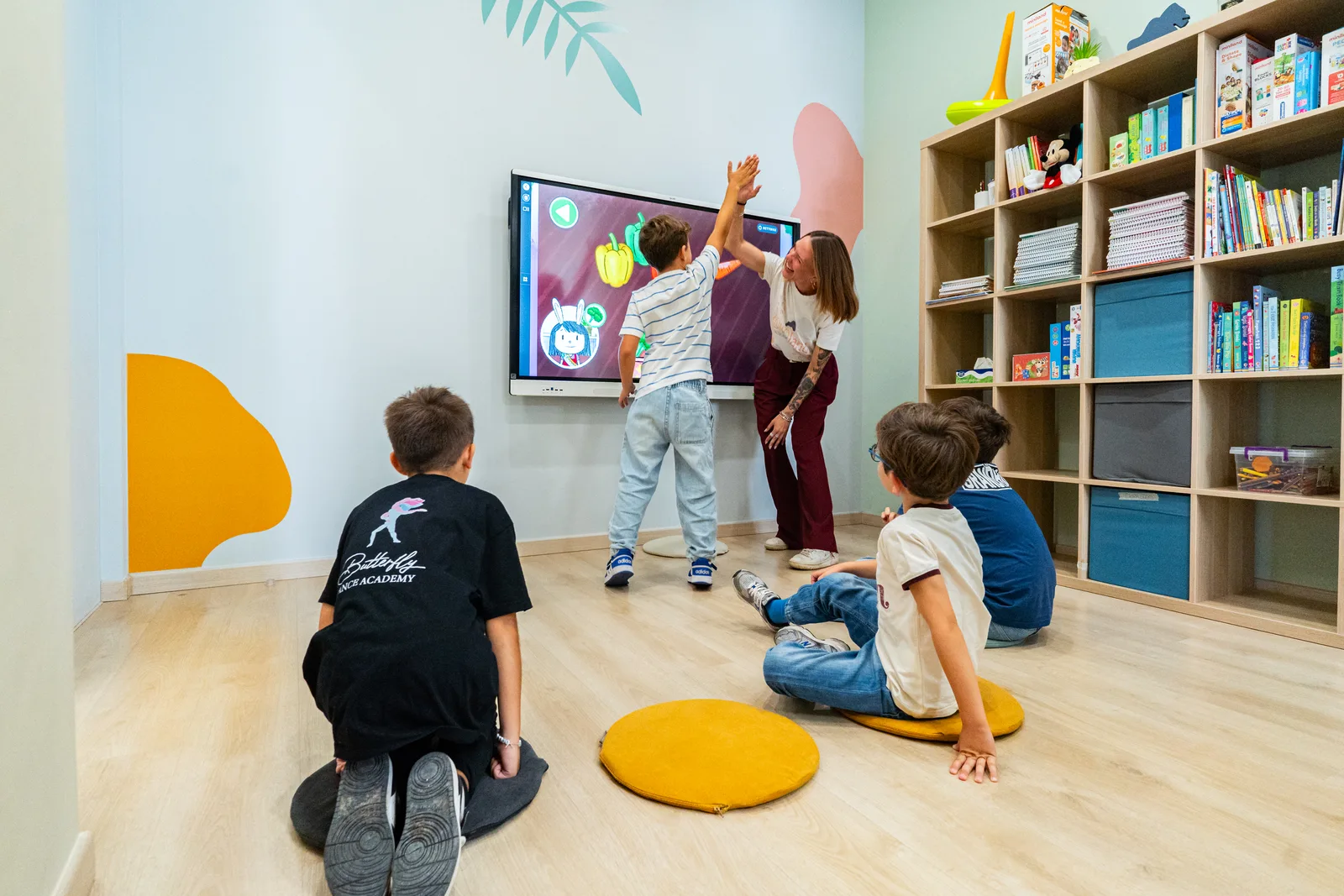
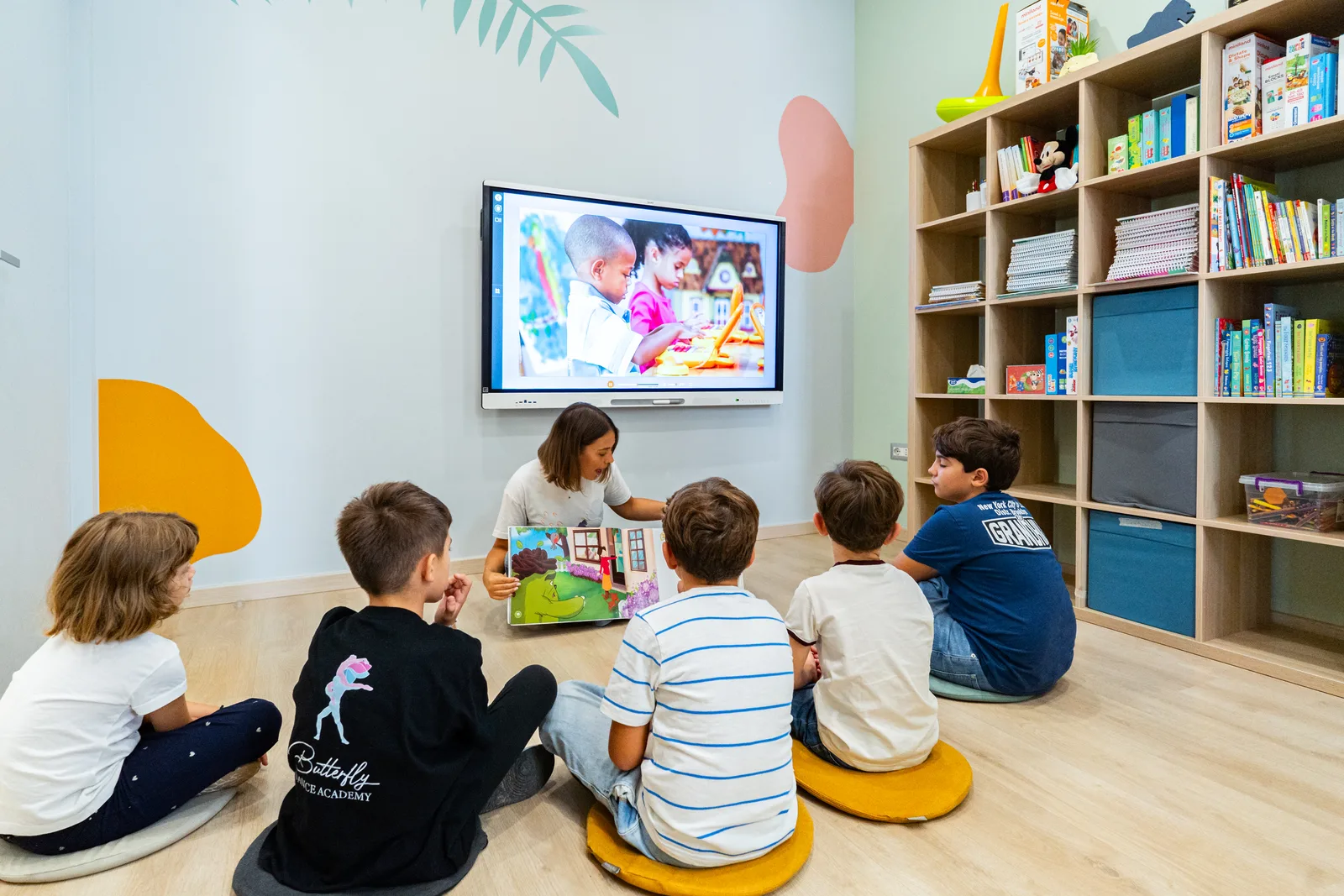
Between 3 and 6, English becomes part of everyday play: songs, stories, movement, the interactive whiteboard. With KOKO Stars, children have two sessions a week: dynamic learning with children their own age, in groups of up to 6, and the Creative Lab, an English-language workshop with mixed ages where younger and older children do the same activity, each in their own way.
From age 7: reading, writing, certifying
With KOKO Primary come reading and writing, and with them the first optional Cambridge exams, which at KOKOland children can sit on-site from age 7. Those who already have a few years of listening behind them get there more naturally.
What if you start at 10 or 14?
You start, and you catch up. With Junior and Teens, the week includes two weekly 60-minute sessions (120 minutes): LANGUAGE LAB — building the language and SPEAK UP — using the language. Conversation, collaboration and problem solving develop alongside Cambridge preparation.
Why it pays not to wait, in Puglia
The 2026 INVALSI data show where the real gap lies. In Puglia, by the end of primary school, 91% of pupils reach level A1 in reading and 81% in listening. By the end of lower secondary school, the target becomes A2: 80% reach it in reading, but only 62% in listening, against 70% for the Italian average. By the final year of upper secondary school, 35% of pupils in Puglia reach B2 level in listening.
At every stage, listening is the skill where pupils fall furthest behind. It’s also the one that can only be trained in one way: by listening and speaking, for years. Starting early means banking exactly that time.
What we see in class
In the classroom, the starting age shows up mostly in how children experience English. Those who start at 3 with KOKO Stars discover it through play, without ever wondering if it’s difficult: they sing, dance, answer, and English simply becomes the language of that place and those people. Those who arrive older pick up the content quickly, but often need a few weeks to trust the process and dive in. They come in shy. They leave smiling.
In Martina Franca, where the pathway began in 2022, there are now children who have spent four years with us and speak English with confidence and ease. Not because of any special talent, but thanks to time, continuity and the enjoyment they’ve brought to it, year after year. Since 2026, the same pathway has been growing in Monopoli too, and now starts at 1 year old, with KOKO Babies.
Frequently asked questions
At what age is it advisable to start teaching English to children?
As early as possible, in ways suited to their age. Even in their first year of life, children learn the sounds of a new language when they hear it from real people, and research shows that starting early and continuing for a long time is the best combination. At KOKOland, children start at 1 year old with KOKO Babies, with a parent in the classroom.
Is it possible to learn English at age 3?
Yes. At 3, children learn English the way they learned Italian: by playing, singing, listening to stories and doing things together with others. With KOKO Stars, from 3 to 6 years old, English enters playtime in small groups of up to 6 children, with native-speaker or perfectly bilingual teachers.
Is 10 years old too late to start English?
No. According to the MIT study published in Cognition in 2018, the ability to learn the grammar of a new language stays high until around age 17. Those who start later can still reach an excellent level, provided they get plenty of exposure and plenty of chances to speak, as in KOKOland’s Junior and Teens pathways.
Come and see it for yourselves
The simplest way to find out if it’s the right moment is to watch children in action. At Demo Day, our free, roughly 30-minute open day, children take part in an English activity in a small group their own age, while you get to know our method, our spaces and our team. We look forward to seeing you in Martina Franca and Monopoli; here you’ll find all our pathways from 1 to 18.
Sources
- Center on the Developing Child, Harvard University: Brain Architecture
- Kuhl, Tsao, Liu (2003), Foreign-language experience in infancy, PNAS
- MIT News (2018), Cognitive scientists define critical period for learning language
- Hartshorne, Tenenbaum, Pinker (2018), A critical period for second language acquisition, Cognition
- Muñoz (2014), Contrasting Effects of Starting Age and Input on the Oral Performance of Foreign Language Learners, Applied Linguistics
- Byers-Heinlein, Lew-Williams (2013), Bilingualism in the Early Years: What the Science Says, LEARNing Landscapes
- INVALSI, 2026 INVALSI test report (regional English-language data)
- INVALSI, 2026 national report: press release of 16 July 2026
Keep reading

Free Demo Day
Try a free Demo Day.
A dynamic learning activity in English, in a small group of children their own age, with the teaching team.